Book of the Week – The Red Moon Anthology 1996
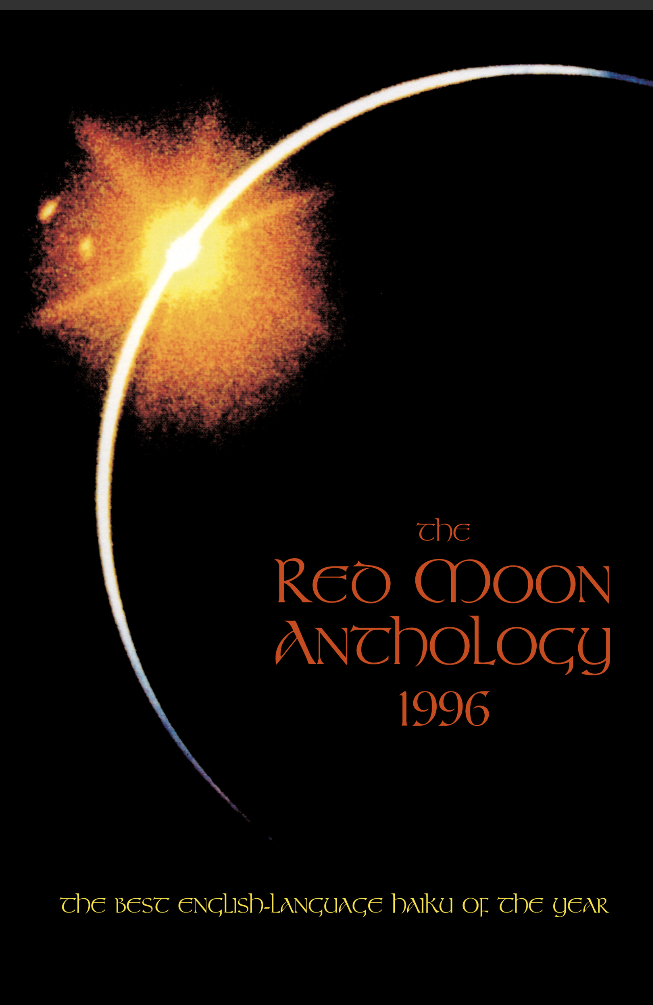
The Red Moon Anthology 1996, edited by Jim Kacian with an international editorial board, gathers what the editors considered the finest English-language haiku and related forms published during the year.
The Foreword clearly frames the project that at certain moments, haiku becomes more than personal expression and enters literature. The anthology sets out to preserve those moments.
The book is organised by form: haiku, senryu, linked forms, haibun, and essays. What emerges is not a single aesthetic but a field of approaches. The opening haiku section moves swiftly between the spare and the quietly expansive. Consider:
noon . . .
the glare of white sheets
on the washing line
The image is stark, nearly blinding. There is no overt commentary, yet the heat and emptiness of midday settle in. The ellipsis slows the reader, allowing the brightness to expand before the sheets come into view.
Elsewhere, emotional depth arrives through restraint. Kay F. Anderson writes:
deep silence
the orphaned nestlings
this third morning
The poem withholds explanation. “Third morning” carries duration and loss without elaboration. We are asked to stand in that stillness.
Pause for a moment as you read through the anthology. Which poems ask you to linger, and which move past quickly? Do you find yourself drawn more to image-driven pieces, or to those where human presence edges closer to the foreground?
The senryu section sharpens its focus on human interiority. Jeremy Bahl offers:
turning the TV off
I appear
on the screen
The humour is immediate, but beneath it is a subtle meditation on self-recognition and emptiness. In another register, Jan Bostok writes:
paralyzed child
her left side
smiles at me
The compression intensifies the emotional field. There is no overt sentimentality; instead, a direct presentation that allows readers to complete the emotional arc.
The linked forms and haibun expand the anthology’s scope. Christopher Herold’s “Voices of Stone” interweaves prose and haiku to record a Zen monastery experience. The haiku
in the fire
a log shifts
the flow of thought
functions as both literal description and metaphor, showing how haibun allows reflection to unfold in layers.
What makes the anthology compelling is its range. We move from pastoral stillness to hospital corridors, from children at play to ageing and memory, from humour to grief. The editorial process, outlined early in the book, required multiple anonymous votes before inclusion, reinforcing that these selections represent shared recognition rather than individual taste.
The Red Moon Anthology 1996 stands as a snapshot of English-language haiku at a particular moment: diverse, international, and increasingly confident in its own idiom. For readers, it offers both pleasure and study. For writers, it provides a map of what was possible-and perhaps still is.
You can read the entire anthology in the THF Digital Library. As you explore it, share one poem that still feels immediate nearly three decades later.
Do you have a full-length or chapbook-length book published in 2021 or earlier that you would like featured as a Book of the Week? Contact us for details. Haiku featured in the Book of the Week Archive are selected by the THF Digital Librarian, Vidya Premkumar and are used with permission.

It was interesting to read this and see how many haiku I already knew including Beary’s “another snowstorm” and Ciubotariu’s “spring” the namesake of the Sharpening the Green Pencil Award. There were also many haiku poets with whom I was not familiar at all and others that are still in active practice. Fascinating.