
Book of the Week – Amongst the Graffiti by Janice M. Bostok
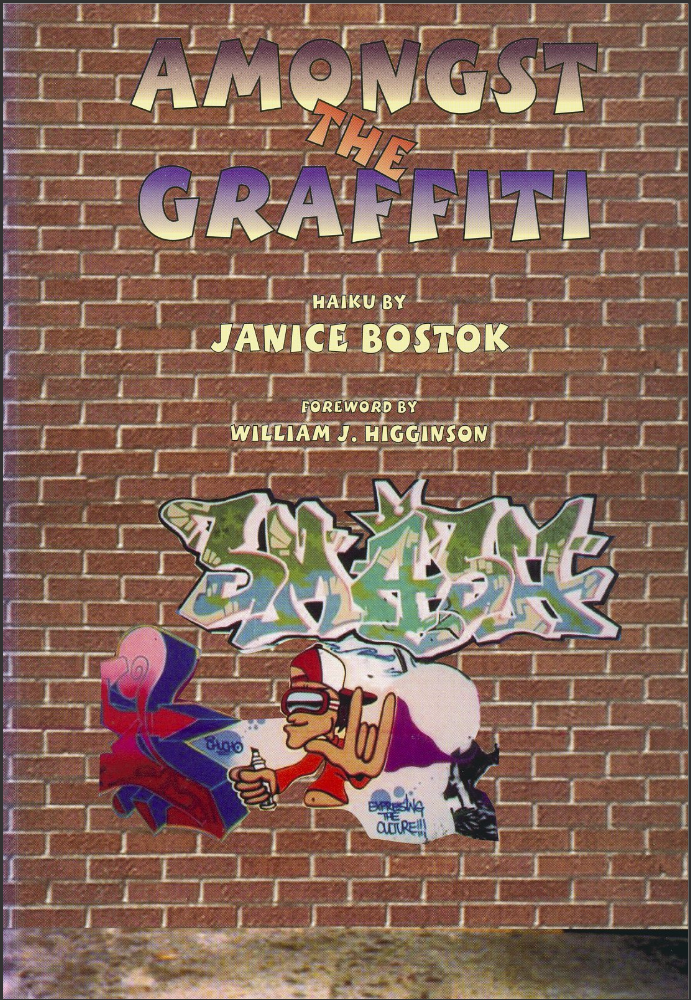
Amongst the Graffiti by Janice M. Bostok is a collection that brings together haiku and senryu composed over a span of thirty years, from 1972 to 2002 published by Post Pressed in 2003. The choice of title directly asserts the book’s stance and perspective within the world it portrays.
The poems in this volume are crafted from within the spaces of daily life, reflecting the authentic experience of inhabiting those places rather than observing them from a distance. Bostok’s work draws from streets, rooms, hospitals, moments of memory, the presence of grief, and the movements that fill everyday domestic existence. There is no attempt to soften or idealise these elements; instead, each is presented as it is encountered, with the world depicted honestly and directly.
The opening sequence sets a tone of unvarnished physical realism.
sleeping horse
angled bones lean
into sunset
The horse in this poem is not offered as a comforting symbol. Instead, its body visibly bears the marks of time, exhaustion, and exposure to the elements. The act of leaning into the sunset is less about seeking rest and more about enduring, demonstrating a body’s quiet persistence as daylight fades. Rather than encouraging the reader to search for reassurance or hidden meaning, the poem invites us to confront and remain with what is plainly present.
Memory frequently finds its way into the collection through specific locations.
in a particular place
in the house I can sense
my dead father
The poem refrains from directly unpacking the memory or specifying an emotion. Instead, it assumes readers are familiar with how certain parts of a home can retain the presence of someone who is no longer there. Here, grief is experienced through space rather than through a detailed narrative, lingering in particular locations rather than unfolding as a story.
Does this haiku remind you of a particular place you either avoid or frequently return to because of the memories it holds? What is it about that place that keeps those memories alive for you?
Bostok keenly observes how attention can be selective and uneven.
only the duck
which is different in colour
is remembered by name
The poem reveals how difference serves as the basis for recognition. In this context, naming is less an act of kindness and more an act of selection. What is singled out for memory does so because it contrasts with its surroundings, while everything else fades into obscurity. Through this, the poem subtly challenges the notion that attention is impartial, suggesting instead that it is shaped by what stands out.
Illness and acts of care are presented plainly, stripped of any sentimentality.
returning home
the hospital smell transfers
from his body to mine
This transfer is tangible and inescapable; care leaves a palpable trace. The poem reveals how closeness can imprint itself on the body, how acts of love naturally cross physical and emotional boundaries. Once the scent passes from one to another, the distinction between self and other dissolves.
Moments of stillness are equally weighted.
she rests awhile
on a fallen tree
fingering the moss
Touch here becomes a means of anchoring oneself in the present moment. The gesture is slow, intentional, and unburdened by expectation. The fallen tree is neither fixed nor grieved over; it remains simply as something to be experienced through touch. The poem grants permission to pause without justification, quietly affirming that mindful attention alone can be meaningful.
Alongside the poems, Amongst the Graffiti features haiga illustrated by Bostok herself. These images are minimal and tactile, mirroring the poems’ restraint. Rather than clarifying or interpreting the text, they exist in parallel, inviting the reader to navigate between looking and reading, between visual mark and written word.
Taken as a whole, the book resists simplifying experience into neat conclusions. Humour, grief, irritation, and endurance sit side by side, unified by an unwavering attentiveness to what often goes unnoticed. Rather than offering escape, these poems provide a sense of recognition.
You can read the entire book in the THF Digital Library. Please share your favourite poem from the book with us.
If you have a full-length or chapbook published in 2021 or earlier that you would like to see featured as our Book of the Week, please get in touch with us for more information. The haiku showcased in the Book of the Week Archive are selected by the THF Digital Librarian, Vidya Premkumar, and appear with permission.

Comments (1)
Comments are closed.
Sublime.