
Book of the Week – Commonplace Book by John Martone
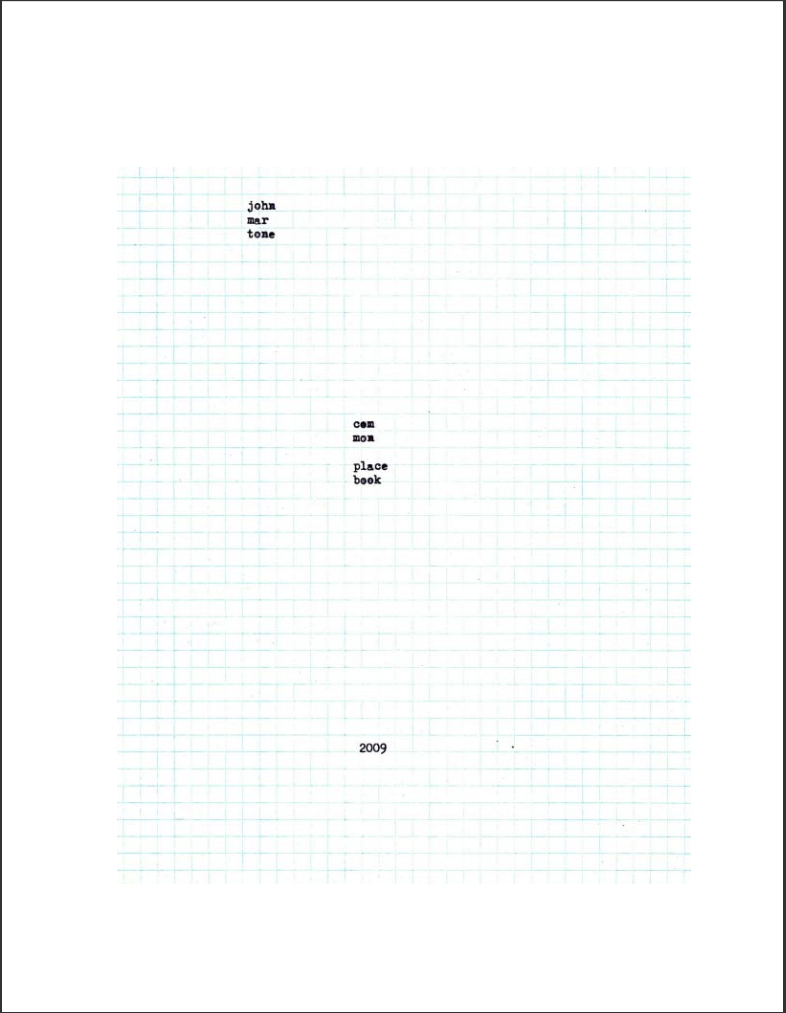
Commonplace Book by John Martone is a visual haiku sequence that blurs the boundaries between a personal notebook, a contemplative meditation, and a study of the sky. Martone, an American poet recognised for his work in haiku, haibun, and haiga, brings a deep engagement with Buddhist philosophy and practice to this collection. Published in 2009, Commonplace Book consists almost entirely of haiga. Each page pairs a photograph of clouds drifting across a blue sky with a brief textual fragment, subtly repeated and repositioned throughout the sequence. The transformation is not so much in the sky itself, but in the evolving way we perceive it.
The book begins with epigraphs that orient the reader toward themes of impermanence, perception, and the fleeting nature of appearances. What follows is a deliberate and sustained visual meditation marked by restraint. A single passage recurs throughout, presented in a small, tentative font, emphasising subtle variation over time.
as stars a fault of vision as a lamp
a mock show dew drops or a bubble
a dream a lightning flash or cloud
so should one view conditioned things
Throughout the book, this Buddhist teaching appears in various positions, sometimes along the edge of the sky, other times beneath the image or slightly askew. Rather than diminishing its significance, the repeated repositioning invites the reader to notice how subtle shifts in placement can influence the emphasis and mood of the words.
Across the pages, delicate symbols or characters drift across the cloud photographs. These elements, reminiscent of notebook doodles, seals, or snippets of handwriting, serve as interruptions in the visual field, prompting the viewer to shift their focus. They resemble Sino-Japanese characters and calligraphic fragments rather than complete words or sentences. In Buddhist visual culture, especially in Zen-influenced practice, single characters, fragments, or seals are often used as contemplative anchors rather than as semantic carriers.
The clouds depicted are intentionally ordinary, with no dramatic weather or striking formations. Martone rejects spectacle, emphasising that it is our attention, not rarity, that gives meaning to what we see.
As haiga, the poetry and images are inseparable; meaning arises between text and sky, reading and looking. The faint grid around each photo evokes a working page, a space for reflection, suggesting the book could endlessly continue with shifting skies and the same soft reminder. Turning each page slows the reading process. Repetition invites comparison, making the subtle differences between cloud density, spacing, and balance more noticeable.
Commonplace Book invites us to inhabit its pages, encouraging a mindful approach to impermanence as something ordinary and present. It shows that a commonplace is not trivial, but a place we return to for clarity.
If you read the book, share with us at what point you stopped reading the words and started simply looking. And when you returned to the words, did they sound the same?
You can read the entire book in the THF Digital Library. Please share your favorite page or moment from the book with us.
Do you have a full or chapbook length book published in 2021 or earlier that you would like featured as a Book of the Week? Contact us for details. Haiku featured in the Book of the Week Archive are selected by the THF Digital Librarian, Vidya Premkumar and are used with permission.

Comments (1)
Comments are closed.
Lately snailmail to John has been returned.
I am wondering if he has moved.