
Book of the Week – Favorite Haiku: Brief Essays 1975-1998, Volume 3 by H. F. Noyes
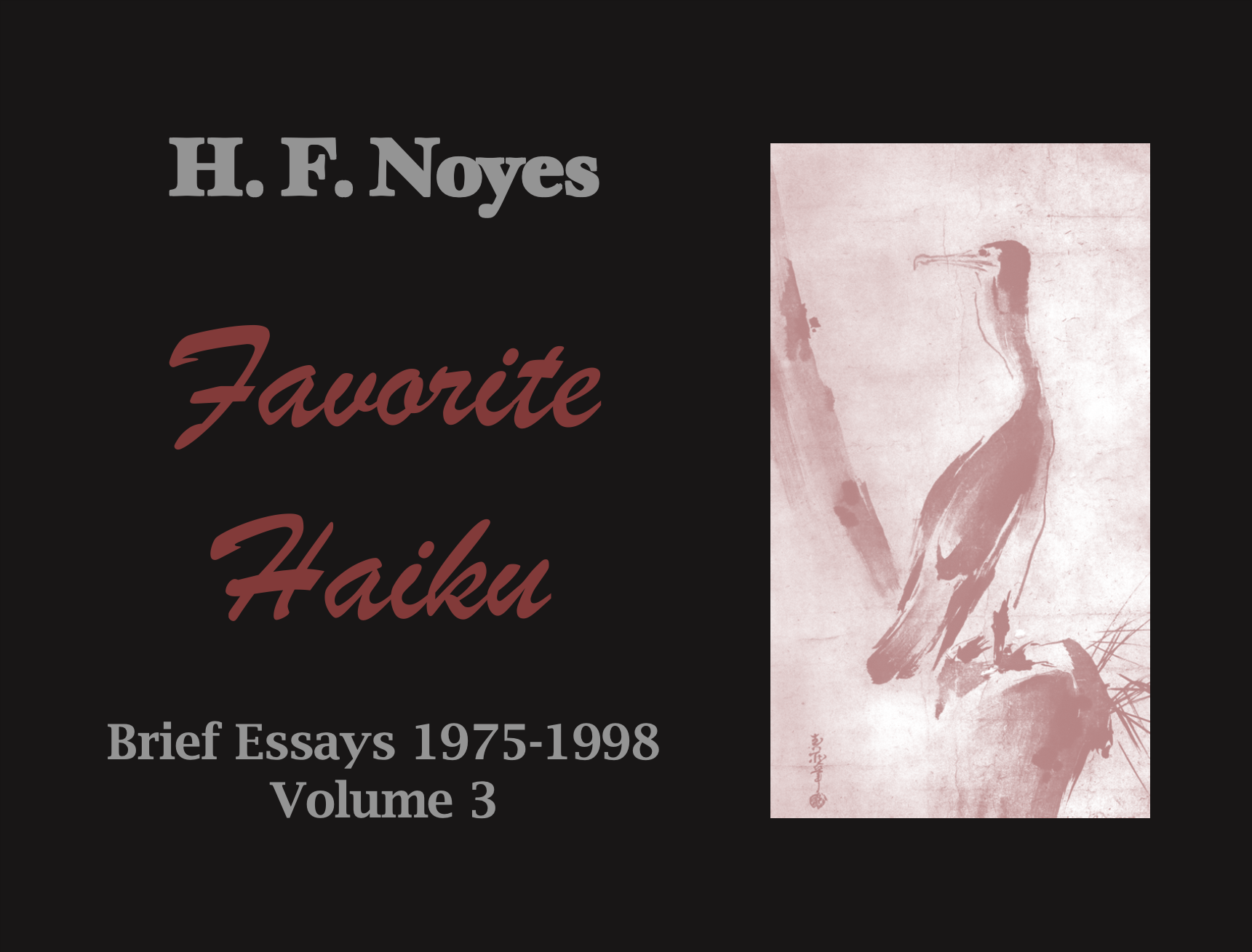
Favorite Haiku: Brief Essays 1975-1998, Volume 3 by H. F. Noyes is not a haiku anthology in the usual sense. It is a record of reading, thinking, and responding to haiku. It is a collection of haiku accompanied by brief critical notes written over more than two decades. Each pair of poem and commentary reveals not just what the haiku presents, but what it can open. Noyes writes from a position shaped by Zen, psychology, literature, and long attention to the form. Before turning to the poems, he offers an introduction to selflessness, detachment, and interbeing, noting that both haiku and senryu, at their best, “emerge from a state of relative detachment” in which self-centeredness falls away and the poet sees inwardly or outwardly with clarity.
The book begins with a haiku by Anna Holley:
the black swan alights:
stars of the Milky Way
lap against the reeds
Noyes calls this “one of the most beautiful examples of nature interpenetration,” emphasizing how stillness and motion coexist, and how “the palpable silence of the lapping stars leads us toward eternity.” His commentary here is typical of the book: close, admiring, and sensitive to how haiku works through suggestion rather than assertion.
From Geraldine C. Little’s haiku:
how silently
the wave-tossed log is beached
and snow-flaked
Noyes draws out the tension between violence and gentleness, reading the contrast as a kind of war and peace. The commentary moves from the physical scene to deeper associations without forcing allegory. What shines through is his belief that simple perceptions can contain complex meanings.
Humor also appears. Jane Reichhold’s poem:
wind
rubbing the lake
the wrong way
leads him to note how colloquial language can animate expression and produce not just recognition but “chuckling release.” For Noyes, the pleasure of haiku is not confined to solemnity; it includes amusement, surprise, and delight.
The collection includes haiku from Basho to contemporaries, and Noyes treats both with the same seriousness. About Basho’s
the winter tempest
hid itself in the bamboos,
and grew still
he connects Blyth’s idea of “perpetual sinking of oneself into things” with the wind’s sudden disappearance into the bamboos. The commentary listens for sound (“the ‘oos’ sound”) and reads the moment as embodiment rather than symbol.
What makes the book distinctive is not only what Noyes says, but how he says it. He quotes Spinoza, Blyth, Job, Whitman, Watts, Pope, and Thoreau, yet these references never overwhelm the haiku. They serve instead as paths into the poems, part of what he calls “reader intuition.”
Favorite Haiku, Volume 3 is best read slowly. It models a way of reading that is receptive rather than analytical, open to mystery, humour, and the unadorned moment. For readers interested in how haiku is received, not just written, this book offers a long, generous apprenticeship in attention.
You can read the entire book in the THF Digital Library. Feel free to share a favourite poem-commentary pairing from the book.
Do you have a full or chapbook-length book published in 2021 or earlier that you would like featured as a Book of the Week? Contact us for details. Haiku featured in the Book of the Week Archive are selected by the THF Digital Librarian, Vidya Premkumar and are used with permission.

Comments (1)
Comments are closed.
I find Noyes very perceptive. He concluded that the essence of haiku was its ‘spirit.’ That notion is of course hard to pin down, and for being non-academic, frustrating for some. But I think he was right. It’s not its form nor its conventional ‘crafting.’ A couple of quotes:
“Out of the rule-free informality of the haiku form, with its emphasis on intuition, will emerge a poetry truly fresh, with a spirit uniquely unbound”
— H F Noyes, Haiku Magic, essay Frogpond XXI.3 and RMA 1999
“Haiku is surely the most elusive form of poetry. Every time one tries to define it, the “rule” is broken in the same week by one of our best haiku poets. But art in all its forms is mysteriously elusive to some degree. Artists are always trying to convey the how of their success, and their explanations are generally of little help to the beginner. What is most vital is that we expose ourselves to the spirit of the art form. The spirit of haiku lies most of all in its simplicity and in its selflessness. Both are a way of life requiring real commitment and depth of understanding. “
—H. F. Noyes “The Way of Haiku” Presence 14 & RMA 2001 “The Loose Thread”