
Book of the Week – Mount Gassan’s Slope by Ann Newell (translated by Kenichi Sato)
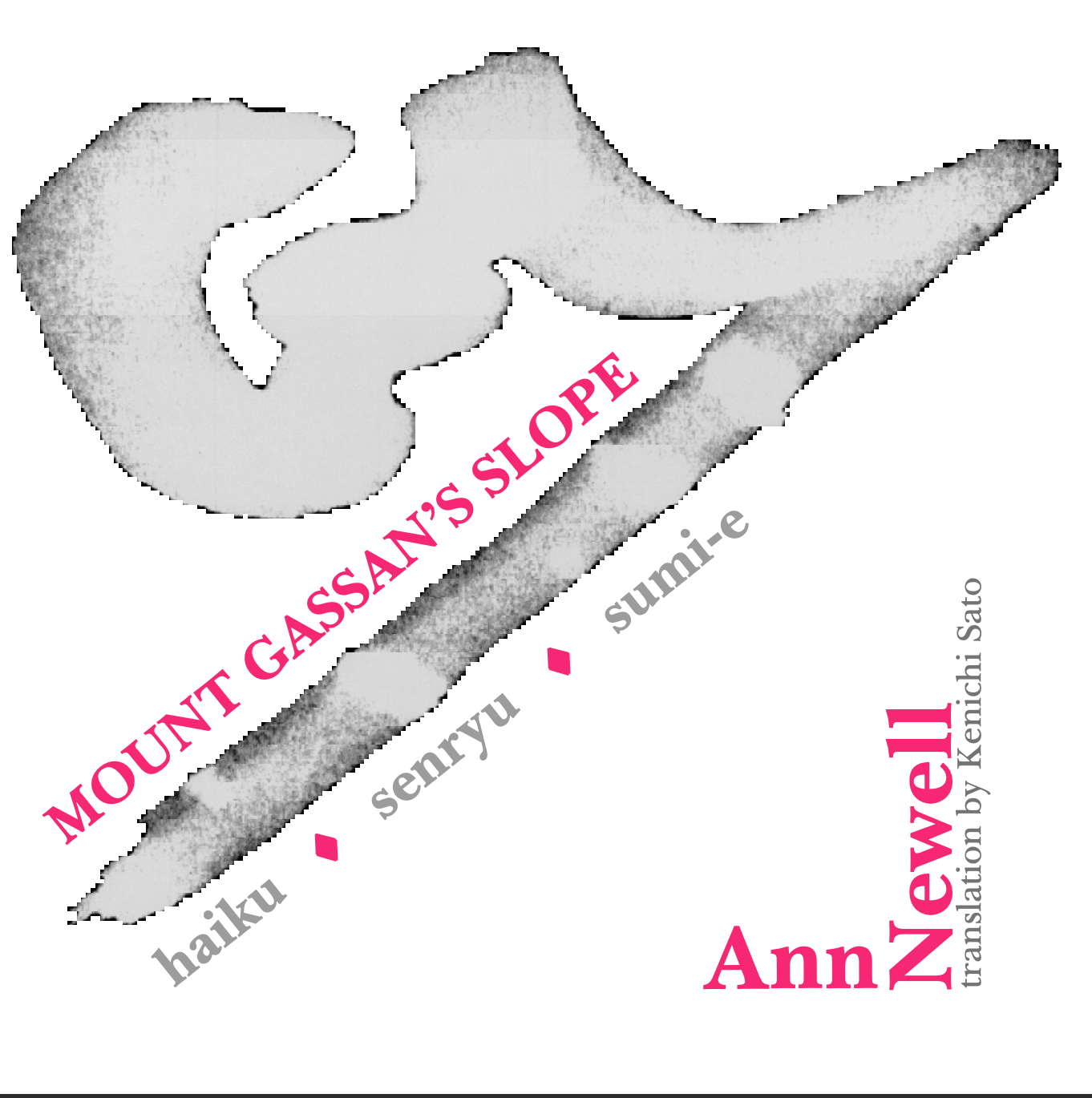
Mount Gassan’s Slope by Ann Newell, with translations by Kenichi Sato, is a bilingual collection of haiku, senryu, and sumi-e drawings published by Red Moon Press in 2002. Newell (1921-2013) was an American poet and artist whose haiku practice grew from a lifetime of reading, teaching, and deep attention to nature and the spiritual dimensions of daily life.
The book opens not with poems but with a rich Preface that links Seoul’s mountains, Japanese sacred landscapes, and Basho’s journeys. Newell recalls how a postcard from Sato, “After yesterday’s skiing on Mount Gassan’s slope am now sitting idle looking at the garden”, set off a chain of insight that led to the book’s title. This framing sets the tone for what follows. The poems and drawings are not just simply arranged by season, but also by a sense of pilgrimage, movement, and discovery.
Each season begins with a brief prose meditation that feels less like an explanation of what is to come and more like an invitation for the reader to experience the season on their own terms. Spring, for instance, opens with:
If I create out of my own imagination,
how can I possibly draw 10,000 things from yours?
I only know I awakened this morning in the silence
of one flower opening.
These prose openings clarify how Newell understands her work to be rooted in attention rather than invention and guided by what she calls “the circle of writing and drawing from an inner spirit.”
The haiku and senryu that follow often bring humour and self-awareness into settings of spiritual seriousness.
in the temple
prone before Buddha
my nose too long
Here, the sacred and the bodily coexist without strain. The sumi-e drawings positioned near such poems echo this balance as it is rendered with restraint.
Newell frequently uses scenes of domestic or rural life to speak beyond themselves. During summer:
in the rain-
lovers holding hands
and one umbrella
The image is slight, but carries weather, intimacy, and a sense of the world continuing beyond the page. Elsewhere, humour turns into philosophy:
sleep doesn’t come
restless flea
to either of us
Rather than expressing frustration, the poem simply notes what is present. The flea serves as both a companion and a reflection of the poet’s own restless state.
Newell focuses on what is immediately accessible, like food, animals, children, bells, roofs, and gardens. Yet, through careful choice and rhythm, these everyday details gather meaning and significance.
In winter, attention returns to the physical body:
falling-
first day of winter
ice cracks my bone
The break is literal, but the poem does not dramatise injury. It registers a fact of the season’s arrival. The fracture is tangible, yet the poem refrains from sensationalising the injury. Instead, it quietly recognises the start of the season as a simple truth.
The sumi-e drawings in the book function more as gestures than traditional illustrations. They do not explain the poems. They share a discipline that is minimal, direct, and driven by both refusal and ink.
Mount Gassan’s Slope presents a record of a life lived in mindful harmony with the world, mountains, temples, neighbours, gardens, ink, and weather. It invites the reader not to interpret but to accompany.
You can read the entire book in the THF Digital Library. If you’d like, share a poem or drawing that stayed with you after reading.
Do you have a full-length or chapbook-length book published in 2021 or earlier that you would like featured as a Book of the Week? Contact us for details. Haiku featured in the Book of the Week Archive are selected by the THF Digital Librarian, Vidya Premkumar, and are used with permission.
