
Book of the Week – Stone Frog: American Haibun & Haiga Volume 2 (eds. Jim Kacian & Bruce Ross)
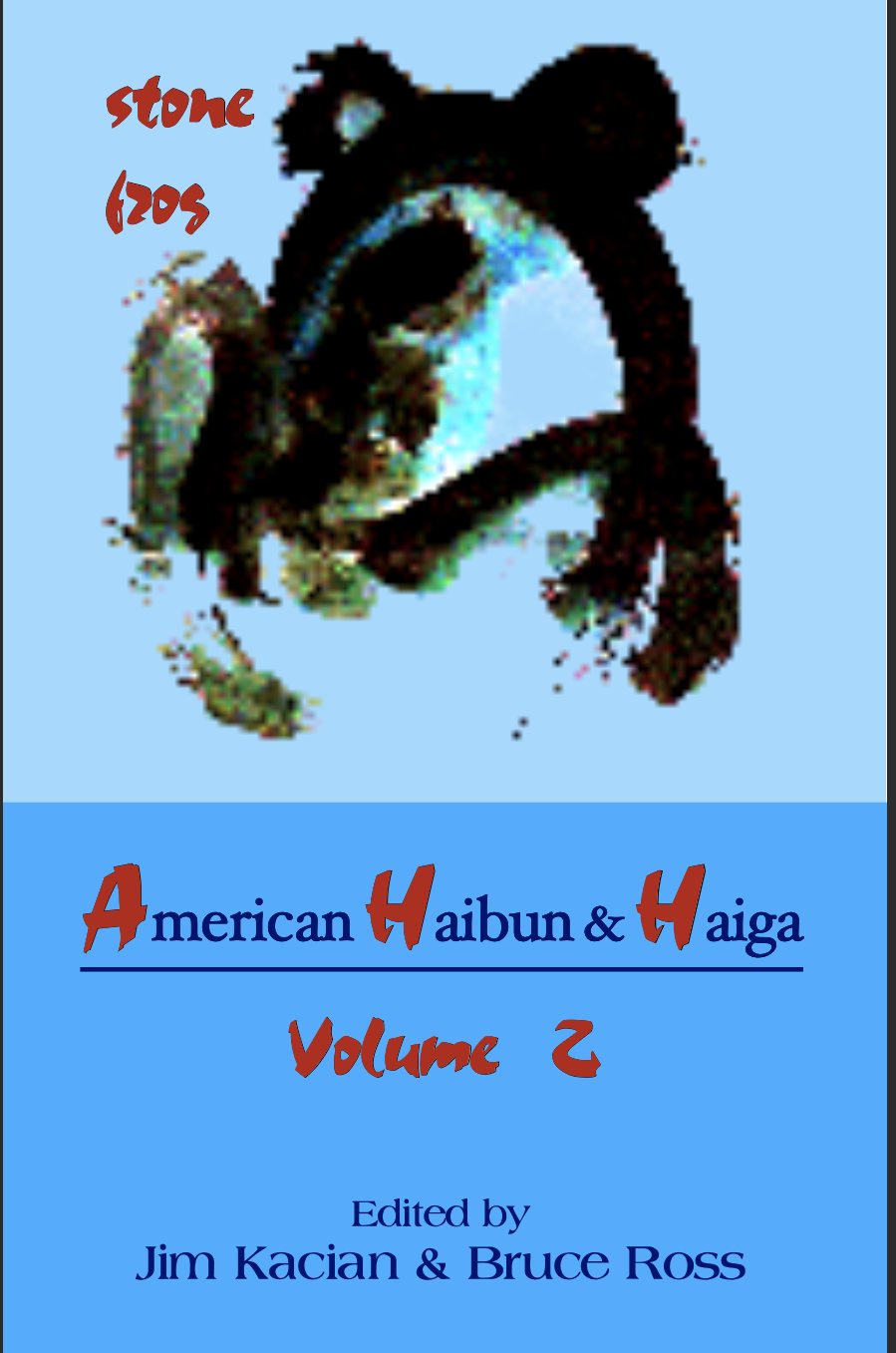
Stone Frog: American Haibun & Haiga, Volume 2 gathers haibun and haiga by writers and artists from America at the turn of the millennium. Edited by Jim Kacian and Bruce Ross, the volume documents a form in motion, autobiographical prose heightened by sentiment, accompanied by haiku, often paired with haiga on the next page. The introduction situates the book in relation to classical models such as The Tosa Diary and Basho’s travel writings and argues that “the manner in which we tell our narrative is as important as the narrative itself,” noting the risks of prosaic flatness and overworked figurative language.
The haibun “refrigerator” by Yu Chang opens the volume with understated grief. A broken appliance leads to the rediscovery of a Christmas card from a friend who “never made it to New York” and died in the Lockerbie bombing. The closing haiku
new fridge
the motor’s faint hum
still there
returns to the neutrality of machinery, letting absence resonate without commentary. The writing is factual, but the emotional charge is unmistakable.
In “At Year’s End,” Margaret Chula recounts a New Year’s Eve ritual in Kyoto with soba noodles, sake, temple bells, and the burning of a Daruma doll. The prose moves briskly, attentive to cultural details without turning explanatory. When her doll repeatedly rolls out of the bonfire, “the Japanese were edging away from me”, a moment both comic and revealing. The haiku
at year’s end
burning the Daruma
with only one eye
leaves the vow unfulfilled, suggesting the complexity of endings in a foreign country.
The anthology also shows how haibun can inhabit historical or political spaces. In John Dunphy’s “Facing the Wall,” the granite of the Vietnam Veterans Memorial reflects visitors’ faces as they read names. The closing haiku
Vietnam Memorial
aging veterans reflected on
names of young men
condenses decades into a few lines, without needing to state the cost.
Alongside the prose works, the haiga demonstrate how word and image can carry different weights while sharing a moment. Zolo’s haiga
the first snowfall …
searching for something I know
I’ll never find
pairs sumi-like abstraction with a poem about desire and futility. The visual field is open, almost evasive, making the unlocated “something” plausible. Later, in a haiga by Jean Konnerth, a single morning glory on a bare vine accompanies the poem
single morning glory
bobbing on a leafless vine
I bring in firewood
and the spare drawing clarifies the season, the cold, and the gesture of bringing the world indoors.
Other haiga are more experimental. The collage by Marlene Mountain treats text and image as equal materials, leaning toward abstraction. Here, the poem functions less as a caption than as another element in a mixed-media field.
What emerges across the book is a range of places, including hospice wards, Thai temples, soccer fields, mountain trails, appliance stores, and memorials. The anthology never claims a single definition of haibun or haiga; instead, it offers evidence that the forms have already naturalised into English and continue to adapt through narrative, sentiment, humour, and experiment.
You can read the entire book in the THF Digital Library. Share a haibun or haiga that stayed with you and tell us why.
Do you have a full or chapbook-length book published in 2021 or earlier that you would like featured as a Book of the Week? Contact us for details. Haiku featured in the Book of the Week Archive are selected by the THF Digital Librarian, Vidya Premkumar, and are used with permission.
