
The Touchstone Awards for Individual Poems 2024
The Touchstone Awards for Individual Poems recognize excellence and innovation in English-language haiku published in juried public venues during each calendar year. In 2024, we received 1405 distinct entries submitted from 43 journals, 8 contest organizers, and 301 individuals in 31 countries.
Panelists:
Gregory Longenecker, Marianne Paul, Agnes Eva Savich, Dan Schwerin, and Mary Stevens
Winners
Brad Bennett
white suburb—
the diversity
of stone walls
(Prune Juice 42 42)
This poem is a 3-5-3 syllable, that begins and ends on two accented syllables, enhancing its message and effect on the reader. “white suburb” seems at first so obvious a reference to racism in the United States that it’s obvious to miss the subtleties in the first word. White would seem to be a reference to what used to be called WASPs: White Anglo-Saxon Protestants. White, however, also carries the notion of innocence and purity. Both can apply in this instance. The perceived innocence many white people have from growing up uninformed about how people of other colors/cultures may suffer in our country and the “purity,” as espoused by white supremacists, keeping white people here as the dominant group.
The second line, “the diversity,” is a key concept as it brings in the current political language of the U.S. Are we going to allow all people to share their language and cultures or only the past dominant race/culture, whites, to share theirs? Of course, the diversity among whites here is never mentioned in political discourse and the history is also ignored. It seems a tacit understanding that only a certain group of whites, a sort of idealized past is allowed. Thus, the past differences between the Germans, Irish, Italians, Slavs, etc., are glossed over in favor of the idea of an idealized white people.
The last line, “of stone walls,” is indicative of the walls between people. Coupled with “diversity,” in line two, it’s apparent that the people being kept out are people of color and ethnic groups, often referred to by whites with the exclusionary language: “non-whites.” Ironically, it is these people — Africans, Chinese, Indigenous, Japanese, Latinos, Middle Eastern, etc. — who have helped this nation achieve greatness. There is the suggestion of a second meaning, however, of stone walls. When we meet an obstacle we cannot overcome, we refer to it as a stone wall or brick wall. “The diversity of stone walls” can therefore also be seen as the variety of objections put up by one group over another. At a glance, these stone walls may appear to be repetitively the same, but, like microaggressions, when you tease apart the different stones and their varieties, there’s a subtlety to the many different insidious forms that white supremacy and/or racism can take. The stone walls, then, can be seen as a series of ways to exclude others based not just on color, but culture, language, and religion. This is a poem rich in secondary meanings.
Mariangela Canzi
Ramadan sunset
sharing dates
in the ruins
(folk ku 3)
Ramadan — a Muslim observance of one month of fasting from dawn to sunset, prayer, reflection, and community. At sunset, a feast breaks the fast each night. In this poem, however, dates are the only food available that is shared, and it is done so in the setting of ruins. It is the word “ruin” which identifies this haiku as taking place in wartime. It still refers to people during a celebration, but now the celebration is subdued. The sharing of dates, normally a part of fast breaking, refers to food scarcity during a time of genocide, such as what’s currently happening in Gaza and elsewhere. It leads us to wonder about the meaning of hunger in the difference between a tradition of holiday fasting and a forced situation of starvation.
Dates, too, can have a secondary meaning, as milestones of specific events. The people “sharing dates” in these ruins can also be commemorating significant moments when that building was bombed, when a home was lost, or when loved ones died. The idea of “sunset” even plays a double role, not just as the beginning of the evening festivities, but also as the ending of one more tragic day, and the metaphorical denouement of yet another battle and the lives associated with it.
Structurally, the longest line is the first, offering a hopeful holding on to the most positive aspects of this haiku; we want to linger in this tranquil scene of the celebratory feast that marks the end of each Ramadan day. The next line offers us the promise of the sweetness of dates, which remains in the mind and on the tongue until the devastating last line: in the ruins. Suddenly that sweet taste turns to ashes as we picture the horrors that happened, despite what is supposed to be a time of gentle reflection and holiday festivities. We are left with ruins, and the bitter feeling of a time of joy subverted into the reality of suffering.
Nevertheless, hope prevails and the principles of Ramadan prevail: not only do we have community (sharing implies people coming together), but also hints of prayer (for those lost in the ruins), reflection (on watching the sunset itself and discussing dates of significance), and the breaking of the fast with what little remains: the sweet taste of dates and the hope of a better tomorrow. This subdued haiku carries a powerful impact.
Cezar Ciobîcá
hospice window
my mother counts
shades of green
(The Haiku Foundation Kukai, July 2024)
The mother in this poem might be visiting a loved one who is near death — a spouse, a sibling, a child, a friend — or she might be in hospice, herself. In line two, we learn she is counting, which is often a self-soothing behavior. We might even think she is counting rosary beads as she prays. In line three, we discover that what she is counting are the shades of green of the trees and shrubs outside her window. Perhaps she is looking with wonder at the abundance in this world, taking in a long last look. So many living things! Perhaps in noticing all the greens, she is going through a process of discernment about what is meaningful, reflecting on various moments in her life and how her having lived matters.
The contrast between the kigo of summer —“shades of green”— and the dying process taking place inside the room is striking, with one way of resolving the tension being the knowledge that life goes on.
The euphony in this poem supports its message. The “s” sounds in “hospice,” along with the “m” and “w” sounds, lend a quietness to this poem; the “g” and “n” sounds in the final word landing in the throat and nose give a feeling of interiority. The word “green” trails off, rather than ends abruptly.
In Close to Home, Thor Hanson describes the “hospital bed study,” in which patients with views of trees recovered more quickly, had less pain, and generally had better overall health and wellbeing than those who had a brick wall outside their windows. As haiku poets, we know this very well! Perhaps the trees can ease the transition into death as well.
Because if its depth of meaning, its use of haiku craft, and its aesthetics, we voted this poem as one of the top four best poems published all year.
Julie Schwerin
the right to bear an alba†ross
(Trailblazer Contest 2024)
When a verb enters stage left in a haiku, pay attention: verbs work hard in a short poem. To ‘bear,’ is to carry and to endure. The battle over the second amendment in this country means that the line, ‘right to bear,’ rolls off the tongue and carries, (bears) associations and battles over what those rights mean, that mean this haiku begins with a decorous stage: the bill of rights, and we anticipate syntax that takes us to a discussion of our rights.
This haiku is upended at that point with disjunction, with the mind making sense of the rest of the poem: what is an albatross? What does the albatross have a right to bear?
An albatross is a large oceanic bird, but now this poem bears a literary allusion from Coleridge’s Rime of the Ancient Mariner’s reference to ‘an albatross of a marriage.’ The second meaning of albatross is to bear an encumbrance, a source of frustration or guilt. The right to bear or not bear was lost to women when Roe was overturned, and the decision of whether to bear or not, was lost, and with it the treatment options for women whose pregnancies are troubled in some way. The right to bear is paradoxically removed by the Supreme Court, but added in this poem as a pregnancy or troubled pregnancy one must endure or must carry. Add the nuance of whether a pregnancy continues, may mean continuing in a marriage or not continuing in a relationship, can make the secondary considerations of marriage or singleness another albatross of the Supreme Court decision.
Most haiku have a reading or two they give the reader, then they bow, pick up their paycheck, and go home. Now this six word — (six word!) poem presents a cross where the ‘t’ stands in the last word, and the last word, if you will, is that the cross has an outsized influence on the last word. This cross is the central symbol of Christianity and some of that faith advocated for decades to outlaw abortion. This symbol is loaded for many — with strong associations and those associations are multiplied as the tall ‘t’ towers over the last word, and the poem. Whether this was cause for rejoicing or lament — the symbol towers over this poem and asks: ‘what is that symbol doing in this poem?’
The cross and its religion is suggested in the word that means to hinder accomplishment, carrying someone else’s cross and someone else’s political view now made your reality by means of losing your rights. Add that ‘alba’ means white — and you have added a little white cross to the poem — of the kind that dot the countryside where tragedies have taken place and must be remembered.
Some may wish that haiku remain strongly associated with nature to be a haiku. This poem bears the stamp of human nature: struggle, political and religious conflicts, and the power of the human spirit to endure.
These six words point to a moment — if you are looking for a moment in this haiku, it was the moment when Roe V. Wade was overturned, and while some rejoiced, for some, it was a gut punch. Maternal care became a minefield for doctors and a nightmare for women and their families with complicated considerations. This poem is original, acutely relevant to our moment, it bears literary allusion, and it whispers the word, ‘bear,’ which calls for human endurance, whatever the albatross.
The Touchstone Awards for Individual Poems 2024 Shortlist
white suburb—
the diversity
of stone walls
— Brad Bennett, Prune Juice Journal, Issue #42
Ramadan sunset
sharing dates
in the ruins
— Mariangela Canzi, folk ku, Issue 3
train from Ukraine…
in his piggy-bank
forget-me-not seeds
— Cezar Ciobica, Frogpond 47:3
hospice window
my mother counts
shades of green
— Cezar Ciobica, The Haiku Foundation Kukai, July 2024
curly fries i morph into a flock of sea gulls
— Susan Beth Furst, Trash Panda #7
single-use petal
the delicate margins
of existence
— Mark Gilbert, 14th Polish International Haiku Contest
lambing
the slow descent
of a raven
— Lorraine Haig, haikuKATHA, Issue 37
buffeting wind
a child blowing bubbles
from her wounds
— John Hawkhead, Martin Lucas Haiku Award 2024
habitat loss
a woodpecker’s
. . . _ _ _ . . .
— John Hawkhead, tsuri-doro, a small journal of haiku and senryu, Issue #20
after despair name your next favorite color
— Peter Jastermsky, Fresh Out Magazine, Nov. 8, 2024
another mother’s day band aid for the exit wound
— Kat Lehmann, ONE ART Haiku Anthology, 2024
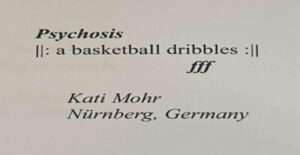
— Kati Mohr, Hauling The Tide, HSA Members’ Anthology 2024
come what may have been autumn twilight
— Christopher Patchel, Upstate Dim Sum 2024/II
explaining spring
to my blind sister
lilac breeze
— Meera Rehm, Leaf Journal, Issue 5
her first period added to the watchlist
— Julie Schwerin, Prune Juice Journal, Issue #42
the right to bear an alba†ross
— Julie Schwerin, Trailblazer Contest 2024
first day of shiva—
the wail of the baby
without her breast
— Sara Tropper, Modern Haiku 55.1
discussing morality
with the dead soldier’s child
rays of the moon
— Sara Tropper, The Pan Haiku Review, Issue 3
chronic illness the rests of my life
— Margaret Walker, Kingfisher #9
for giving and for getting plum stones in the icebox
— Marcie Wessels, Heliosparrow Poetry Journal, January 7, 2024
alone
a meadow
makes me its weed
— Peter Yovu, The Heron’s Nest, Volume XXVI, Number 3
The Touchstone Awards for Individual Poems 2024 Longlist
caesarean section —
what it costs the river
to move a stone
— Meredith Ackroyd, #FemkuMag, Issue 35
snowberry clearwing
the mouthfeel of a name
for our baby
— Meredith Ackroyd, #FemkuMag, Issue 35
hospice bed
just enough space to sit
at the edge
— Susan Antolin, Kingfisher #9
white suburb—
the diversity
of stone walls
— Brad Bennett, Prune Juice Journal, Issue #42
recent layoff —
the weight of the kids
climbing his back
— Shiva Bhusal, Frogpond 47:3
Ramadan sunset
sharing dates
in the ruins
— Mariangela Canzi, folk ku, Issue 3
thrift store
do I look like
an American
— Yu Chang, Upstate Dim Sum 2024/II
train from Ukraine…
in his piggy-bank
forget-me-not seeds
— Cezar Ciobica, Frogpond 47:3
hospice window
my mother counts
shades of green
— Cezar Ciobica, The Haiku Foundation Kukai, July 2024
church bells
my daughter’s laugh
becomes religion
— Shane Coppage, Prune Juice Journal, Issue #44
one buttonhole begins to sing the winter wind
— Robert Epstein, whiptail: journal of the single-line poem, Issue 11
first day of fall
I find an acorn
in my breast
— Adele Evershed, Wales Haiku Journal, Autumn 2024
yes*
— P. H. Fischer, hedgerow #146
the heft
of a spring cabbage
her laughter
— Emily Fogle, Geppo, XLIX:3, August 2024
curly fries i morph into a flock of sea gulls
— Susan Beth Furst, Trash Panda #7
resting on the bench
at the end of the path
someone else’s mother
— Ben Gaa, hedgerow #145
single-use petal
the delicate margins
of existence
— Mark Gilbert, 14th Polish International Haiku Contest
just a highway till that white cross
— Benedict Grant, Blithe Spirit 34.2
lambing
the slow descent
of a raven
— Lorraine Haig, haikuKATHA, Issue 37
buffeting wind
a child blowing bubbles
from her wounds
— John Hawkhead, Martin Lucas Haiku Award 2024
habitat loss
a woodpecker’s
. . . _ _ _ . . .
— John Hawkhead, tsuri-doro, a small journal of haiku and senryu, Issue #20
sunrise
the river
changes key
— Lee Hudspeth, The Heron’s Nest, Volume XXVI, Number 1
after despair name your next favorite color
— Peter Jastermsky, Fresh Out Magazine, Nov. 8, 2024
open season—
no bag limits
on women
— Julie Bloss Kelsey, #FemkuMag, Issue 37
. . . ings and rift in gs an dr if ting san dri ft ing sand . . .
— Julie Bloss Kelsey, The Pan Haiku Review, Issue 3
another mother’s day band aid for the exit wound
— Kat Lehmann, ONE ART Haiku Anthology, 2024
a deep sigh
blows out the votive
late winter rain
— Kristen Lindquist, Akitsu Quarterly, Fall/Winter 2024
summer theater
a trap door opens
under the stars
— Scott Mason, The Heron’s Nest, Volume XXVI, Number 3
— Kati Mohr, Hauling The Tide, HSA Members’ Anthology 2024
his walking stick
when I need
to talk
— Peter Newton, Modern Haiku 55.2
if only men too seahorses
— Debbie Olson, #FemkuMag, Issue 35
hash brownies
somewhere out there
a call’s loon
— Vandana Parashar, Prune Juice Journal, Issue #44
come what may have been autumn twilight
— Christopher Patchel, Upstate Dim Sum 2024/II
…………………………………………sandpiper
— petro c.k,, Porad Haiku Award 2024
autumn skies
another loop released
from the kite reel
— Dru Philippou, Peggy Willis Lyles Haiku Awards 2024
falling leaves
the gentle pulse
of the oxygen tank
— Marilyn Powell, Frogpond 47:3
explaining spring
to my blind sister
lilac breeze
— Meera Rehm, Leaf Journal, Issue 5
knitting off gauge
again begin to
takes it rain what
— Michele Root-Bernstein, Acorn 53
rape in wartime
Granny’s experience
and mine
— Nuri Rosegg, Asahi Haikuist Network, Asahi Shimbun, December 6, 2024
ashen as ash as hen
— Ernesto P. Santiago, dadakuku, October 18, 2024
deep drought
a dab of perfume
on the rainmaker’s wrist
— Kelly Sargent, Frogpond 47:3
winter pine boughs
the weight
of a child’s why
— Kelly Sargent, Leaf Journal, Issue 5
her first period added to the watchlist
— Julie Schwerin, Prune Juice Journal, Issue #42
the right to bear an alba†ross
— Julie Schwerin, Trailblazer Contest 2024
first day of shiva—
the wail of the baby
without her breast
— Sara Tropper, Modern Haiku 55.1
discussing morality
with the dead soldier’s child
rays of the moon
— Sara Tropper, The Pan Haiku Review, Issue 3
chronic illness the rests of my life
— Margaret Walker, Kingfisher #9
for giving and for getting plum stones in the icebox
— Marcie Wessels, Heliosparrow Poetry Journal, January 7, 2024
alone
a meadow
makes me its weed
— Peter Yovu, The Heron’s Nest, Volume XXVI, Number 3
The Touchstone Distinguished Book Awards 2024
85 books were nominated. Award recipients are listed in alphabetical order by author, not by merit. Selected comments from the panelists give some flavor of the deliberations.
Panelists:
Susan Antolin, Joyce Clement, Cody Huddleston, Peter Newton, Christoper Patchel
Winners
Francine Banwarth
Bare Necessities (Taylorville, IL: Brooks Books, 2024)
It’s hard to believe that Bare Necessities is the first published haiku collection of accomplished poet & editor Francine Banwarth. It has been a long time coming and was well worth the wait.
This collection of selected haiku is arranged in chronological order spanning 35 years from 1989 to 2024. As such, we get to observe how the forms and themes of Banwarth’s haiku evolved. The Author’s Introduction, and Michele Root-Bernstein’s insightful Reader’s Introduction further extend our understanding of the origins and influences that help shape the first-rate haiku that follow.
From beginning to end the haiku included in this collection are multidimensional.
They are layered in meaning:
giving itself
to the greater go(o)d
raindrop
one bird sings inside another autumn dusk
darkness
I lock
myself in
They are lush in sound:
water calls them
out of the sky
wing-worn geese
to know the light
the way a leaf
falls through it
spring morning
the sweetness of the pasture
in the cream
milkweed silk parsed into syllables of light
They are evocative of heart and mind:
a circle of light
the long necks of swans
dipping in
late winter twilight
he comes home
without the dog
butterfly garden…
a big voice answers
a small one
newborn’s death date no wind to speak of
And they are not without their humor:
flesh and guts
the pumpkin
stares back at me
The advantage of a 35-year retrospective is the opportunity to discover and follow a wide variety of thematic paths through a landscape of time. Whether by season or image, life stages & experience, family & relationship, or by other poetic elements, each exploration invites reading and re-reading which can reframe and offer new perspectives that yield rewarding results. Following different paths allows haiku which may have been underappreciated in one reading to rise up and reverberate in another. Haiku encountered at the trail’s end can ripple back to those encountered at the beginning and create for the reader an ever-deepening experience.
One such example is the rich vein of recurring moon imagery in Banwarth’s haiku. Her moons share a deep connection with expression itself. They appear where words are inadequate or don’t yet exist. They substitute for that which is not quite language-able. They are present or missing depending on what the speaker chooses to reveal or keep hidden.
solace
the moon
sometimes
holding my thoughts
in moonlight
his point of view
no moon tonight
I tell him what
he wants to hear
moon under the clouds
the things we talk about
when our eyes don’t meet
enough said
the moon rises
out of the sea
Bare Necessities is not a book to be shelved. It is one of those haiku collections to keep close at hand and revisit often.
Alexis Rotella
Milkweed (Taylorville, IL: Brooks Books, 2024)
This beautifully-produced, hardcover collection presents the highlights of a many-decades-long writing practice by one of the pioneers of English-language haiku, Alexis Rotella. In the Author’s Preface, we learn that in the 1970s Rotella became fascinated by what she described as “tiny capsules of energy—word photographs that looked so easy to write.” That perceived ease turned out to be deceptive, as many of us also discovered in our early attempts at writing haiku. Rotella’s first acceptance from a haiku journal came from Randy Brooks, who published the following senryu in High/Coo Quarterly:
Husband home
from work
haiku for dinner again
It is fitting that all these years later, Brooks has published this retrospective of Rotella’s selected work. It is also interesting to note that Rotella’s first published senryu is representative of her consistent interest in human relationships. Milkweed is dedicated to her late husband, Robert Rotella, and poems in which he figures appear throughout the collection, making it, among other things, a touching tribute to a long marriage.
In bringing us the selected work of particularly accomplished haiku poets in recent years, Brooks Books provides a valuable resource for readers. Gathering the best haiku from a long list of prior publications, these greatest-hit retrospectives give readers a sense for a poet’s range of work in a single volume. In Rotella’s case, the list of her previous books spans three pages. Milkweed gathers the best poems from Rotella’s prolific career and incorporates recent edits by the author.
Rotella is best known for her evocative senryu, such as the following classic:
Late August
I bring him the garden
in my skirt
Other equally moving senryu in the collection include:
Undressed—
today’s role dangles
from a metal hanger
Just friends
he watches my gauze dress
blowing on the line
Opening his
dresser drawer—
darkness slips out
In addition to her delightful senryu, this collection contains many nature-themed gems as well, each with Rotella’s characteristic style.
Hummingbird
tuning
the lily
Telling its side
of the story
gurgle of the creek
Cranking up
the sky
geese
But the poems that captivate us most strongly are those in which Rotella highlights small moments with particular emotional resonance:
Under the covers
he opens the jar—
fireflies
Dawn
the robin sings
your eulogy
The clean presentation of the poems without publication history makes for an aesthetically pleasing read. While the collection encompasses Rotella’s forty-five years of haiku, it is important to remember that this book is a “selected” not a definitive “collected” volume. She is very much alive and still writing. We are grateful to have more of Rotella’s poems to look forward to.
Peter Yovu
shine shadow (Winchester, VA: Red Moon Press 2024)
Among the many books we considered for this award, Peter Yovu’s shine shadow was a clear stand-out collection. The poet’s inventive use of language to present wholly unique images rewards the reader on each successive visit to the world Yovu creates. The poems inform and strengthen each other while demonstrating a thought-provoking writing style by a skilled wordsmith. This collection shows us the depth and breadth of what haiku-inspired poems can do. And it serves as an excellent example of how haiku and free verse poetry might coexist.
Bruce Ross, a haiku poet and scholar, wrote in an essay what we feel applies to the skills and accomplishment of Yovu’s most recent collection.
“What needs to happen when experiencing a haiku moment, that heightened experience whether in a meditative, reflective, or exuberant state, is the crafting of an “absolute metaphor” that joins the universal and the particular in stated or unstated imagery to produce a musically phrased dynamic of new awareness.”
Yovu does this with expert regularity. Here is one example:
two ballerinas in one skin a newborn foal
And another example:
taken up by a hawk
every letter of
a snake’s alphabet
In both of these poems Yovu takes what may be familiar (a foal’s first steps, a hawk capturing a snake) and remakes each into new images that surprise the reader. Additionally, the fact that the snake is actually communicating through its own mysterious alphabet adds another layer to this poem and reinforces Yovu’s larger theme of language and its possibilities.
In addition to the stand-alone short poems, Yovu includes haibun, short free verse poems and a series of one-line sequences. The haibun that are interspersed throughout the book convey a deep emotional connection to the natural world and the roles we humans play in it. Each haibun succeeds, in part, because of Yovu’s close attention to the interplay between the title, prose, and haiku. Again, multiple readings reward the reader in multiple ways. For example:
First Floor
He died. For a long time it seemed I had taken on his body, and mine was its shadow.
glow-in-the dark-stars
on my bedroom ceiling —
someone coughing,
above
Yovu employs the metaphor of shadows in this collection, as the title clearly suggests. In this briefest of haibun, the poet seems to be referencing his father who is featured in the poem that immediately precedes this haibun:
my father
dying —
sun glints on the nail
a painting hung from
The reader is left to ruminate on what painting hung on that nail. Where did it go? And what was its significance to the father? In “First Floor” the reader receives only the barest of details to what is an emotionally loaded scene about a much larger absence. And is it also a commentary on “the man upstairs?” Is the coughing from above a comment on how casually life goes on? Is it God simply going about his business? Additionally, there’s the intentional reference to the illness of whoever “he” is who died.
Peter Yovu’s words in shine shadow are striking, no matter what form he chooses to contain them. Yovu’s singular viewpoint is strange and appealing, coaxing the reader from their comfort zone with the alluring force of language. He blurs the conventional definitions of what a haiku is, what a haibun is and even what a poem is. As a result, readers are sure to find a world as limitless as their own imaginations.
Honorable Mentions
Roberta Beary
Carousel (Ormskirk, UK: Snapshot Press, 2024)
As with Roberta Beary’s three previous haiku collections, Carousel takes readers on an emotional journey. Throughout this journey, the poet makes essential connections and creates an immediate impact with each haiku.
skylight moon
my unspoken need
for boundaries
isolation ward
mom says i don’t look good
in blue
threading the robin’s nest frayed sunset
Beary avoids the often-used tropes found in many contemporary haiku allowing for refreshing new takes on a variety of subjects. Themes of family relationships and emotional trauma are explored with a wise, forgiving tone.
mother gone
moonlight shimmers
the last white rose
divorce day
hand-picking
perennials
As a poet identifying as gender fluid, Beary writes to connect with others outside the gender binary and express the need to “give voice to the voiceless.” With careful attention to the placement of each word, Beary creates a narrative arc that delivers readers from isolation to connection.
non-binary below blue ocean eyes
water lilies
a murmur of voices
drifts into dusk
almost summer
the smell of wet paint
on the carousel
The title poem juxtaposes the new and the nostalgic. A carousel, perhaps decades old, is receiving a fresh coat of paint. Readers can imagine taking their children to ride the same carousel they rode as children. We’re grateful to Beary for taking us on this insightful, poignant ride.
Benedict Grant
winterizing (Winchester VA: Red Moon Press, 2024)
This book was a welcome surprise for those of us unfamiliar with Benedict Grant or his previous book, Spirit Level, which was shortlisted for a Touchstone in 2022.
The title, Winterizing, accurately forecasts the overall theme and tone of the book. And the epigraph, a quote from Thoreau, further indicates:
“In winter every man is, to a slight extent, dormant, just as some animals are but partially awake…”
What this collection of poems depicts, however, is not the natural winter season so much as a season of life—a winter of the soul—irrespective of the calendar year. One of those long hard stretches when you just want to hibernate. But dormant or not, Grant the poet is fully awake:
these mountainous wee small hours
morning dew
just a little something
for the pain
graveside service
stumbling to the end
of the poem
This highly personal winter is also reflected in the larger state of the world:
while we struggle
to define democracy
dandelions
small town
the ash of a cigarette
holding its form
While most of the poems are in minor keys, with little in the way of sweetness and light, there are bittersweet moments along the way:
late night call
the distant shore
a little closer
And there are elements of irony and humor:
end of days—
but first a few words
from our sponsor
an anguished scream
from a tortured soul
pulling up a chair
These poems, whatever key they’re in (or form they take, or experience they limn), sound pitch perfect to the ear, the mind, and the heart. The book is an engaging read with a satisfying arc from start to finish. By the last chapter that long winter has finally run its course and given way:
fresh start
switching from portrait
to landscape
once again
for the first time
spring
Roland Packer
no heroic measures (Winchester VA: Red Moon Press, 2024)
Despite writing haiku for more than forty years, Canadian musician and poet Roland Packer has never before released a full-length collection. Our panel found the 97 poems that comprise no heroic measures worth the wait.
The collection is subtitled “haiku and related poems,” a seeming acknowledgement of the pieces that take typographical liberties in creating meaning:
a bottle
on the interstellar sea . . .
↑
you are here
to
tem
y
our
s
tor
y
be
come
s
mine
These poems—placed as they are amongst more traditional haiku offerings—come across as emotionally resonant discoveries rather than simple novelties. This is especially true since, as expected from a long-time, widely published haiku poet, the collection exhibits a full range of haiku techniques. Particularly powerful are the monoku:
so soft the snow no heroic measures
The meaning of the term “heroic measures” appears to be two-fold: It refers to heroic couplets—rhyming pairs of lines in iambic pentameter commonly used in epic and narrative poetry. It also refers to treatment used to save or extend a person’s life despite the harm such treatment may cause. (The most well-known examples of heroic measures include CPR and amputation.) Throughout the collection, there is indeed a sense not of giving up, but of acceptance, such as the closer:
as they were as they are starry night
And the numbingly poignant:
between this world and the next morphine
Some of the poems speak to a quiet inner strength:
Goldilocks zone
I
of the storm
outlasting
everyone she loved—
heartwood
The emotional palette of the book is filled out by its author’s passions, which include music and astronomy:
street tune
an elderly couple
step into a waltz
our plans
mapped with care
the canals of Mars
We find Packer’s collection to be an innovative, balanced, and meticulously crafted work. While the measures taken may not have been heroic, they were certainly successful.
The Touchstone Distinguished Books Award 2024 Shortlist
Banwarth, Francine. Bare Necessities. (Taylorville, IL: Brooks Books, 2024).
Beary, Roberta. Carousel. (Ormskirk, UK: Snapshot Press, 2024).
Evetts, Dee. city beach. (Winchester, VA: Red Moon Press, 2024).
Grant, Benedict. winterizing. (Winchester, VA: Red Moon Press,, 2024).
Hambrick, Jennifer. a silence or two. (Winchester, VA: Red Moon Press, 2024).
Kolodji, Deborah P. Vital Signs. (Lakewood, OH: Cuttlefish Books, 2024).
Lucky, Bob. My Wife & Other Adventures. (Winchester, VA: Red Moon Press, 2024).
m., Paul. magnolia diary. (Champaign, IL: Modern Haiku Press, 2024).
Packer, Roland. no heroic measures. (Winchester, VA: Red Moon Press, 2024).
Rotella, Alexis, Milkweed (Taylorville, IL: Brooks Books,2024)
Strange, Debbie. Random Blue Sparks. (Ormskirk, UK: Snapshot Press, 2024).
Yovu, Peter. shine shadow. (Winchester, VA: Red Moon Press 2024).
The Touchstone Distinguished Books Award 2024 Longlist
Banwarth, Francine. Bare Necessities. (Taylorville, IL: Brooks Books, 2024).
Beary, Roberta. Carousel. (Ormskirk, UK: Snapshot Press, 2024).
Black, Rick. Two Seasons in Israel. (Arlington, VA: Turtle Light Press, 2024).
Chang, Yu. raking leaves. (Winchester VA: Red Moon Press, 2024).
Cooper, Bill. two summers. (Winchester, VA: Red Moon Press, 2024).
Evetts, Dee. city beach. (Winchester, VA: Red Moon Press, 2024).
Grant, Benedict. winterizing. (Winchester, VA: Red Moon Press,, 2024).
Hambrick, Jennifer. a silence or two. (Winchester, VA: Red Moon Press, 2024).
Kolodji, Deborah P. Vital Signs. (Lakewood, OH: Cuttlefish Books, 2024).
Lucky, Bob. My Wife & Other Adventures. (Winchester, VA: Red Moon Press, 2024).
m., Paul. magnolia diary. (Champaign, IL: Modern Haiku Press, 2024).
McKeon, Joe. a man on horseback. (Winchester, VA: Red Moon Press, 2024).
Ortiz, Victor. gone / to seed. (Durham, NC: Backbone Press, Durham, NC, 2024).
Packer, Roland. no heroic measures. (Winchester, VA: Red Moon Press, 2024).
Rotella, Alexis, Milkweed (Taylorville, IL: Brooks Books,2024)
Strange, Debbie. Random Blue Sparks. (Ormskirk, UK: Snapshot Press, 2024).
Turner, C.X. Evergreen. ((Uxbridge, UK: AlbaPublishing, 2024).
Yovu, Peter. shine shadow. (Winchester, VA: Red Moon Press 2024).
The Touchstone Awards for Individual Haibun 2024
Two hundred fifty haibun were nominated by poets, readers, and editors around the world, from dozens of journals, books, and contests. After much deliberation, the three panelists narrowed the field to a Long List of 15 haibun, then a Short List of seven. This third and final round recognizes four haibun with the highest honor of Awarded.
These Awarded works represent the very best of the English-language haibun that were published last year, and the overall high quality and creative diversity of the nominated works made the selection choice an enjoyable challenge for the panelists. Thank you to all the editors who published or otherwise showcased haibun in this past year and individuals who published/read and nominated haibun this past year. And thank you so much to the hard-working haibun panelists for their time, effort, and expertise in making these selections and writing the commentaries.
Panelists: Lorraine Padden, Renee Owen, and Marietta McGregor.
Winners
Grief: The Uncut Version
childhood desk
i trace initials
no longer mine
Life is a scratchy film reel that plays in your head, your mother swanning into the solarium that overlooks the pool; life is her eyeing you from her loveseat perch, on her lap pink crocheted squares and the latest Dick Francis; life is you laughing when she says, Roberta, all kidding aside, you could stand to lose a few pounds maybe eat more salads, and even though you will sell the Florida condo, life is spending an hour looking at its staged photos, zooming in on what your mother calls the solarium and you call the sunroom just to hear her brusque correction; life is the warmth of the sun on your face as you curl up under her afghan no one else wants, while reading Dick Francis for the umpteenth time; life is letting the book fall from your hands as you close your eyes, a scratchy film reel playing in your head, your mother swanning into the sunroom solarium sunroom solarium sunroom.
10 years gone clouds shift a broken stairway
— Roberta Beary, MacQueen’s Quinterly Issue 24
Among many compelling themes explored by haibun poets, grief is surely one of the heavy hitters.
While these stories often reflect distinct practices and traditions, profound loss read through a haibun lens may also hint at universality, of shared human experience, including and perhaps surpassing specificities of culture, time, or place.
Of course, details do matter, and part of the innovative plunge offered by Grief: The Uncut Version relies on a reader being invited to dwell in the literal headspace of a particular poet mourning the loss of their mother. Through skillful use of repetition, sparse punctuation, and cinematic flashback, the poet shapes the narrative into the ruminating stuff of grief itself, not a story about those ruminations.
The prose content—snippets of remembered images, thoughts, dialogue heard and reheard—subtly morph across the span of the poem, just as they might shift across the arc of a lived experience. By the time the initial line of the prose reappears at the end of the paragraph, the order of repeated words is slightly altered, yet the scratchy film reel remains, still looping across an unfolding (and refolding) bereavement process. That each of these snippets opens with the phrase Life is serves as a poignant reminder of just how all-consuming that process can be.
The two haiku bracketing this churn also play a role in framing an intimate stream of consciousness as it evolves over time. The subtle mystery of the opening poem alludes to past identity now transformed, while the final monoku reminds us how the accommodation of loss matures at its own pace—in this case, a continuum of ten years, and counting.
Finally, the title Grief: The Uncut Version delivers a reader directly into a ferment of moments that, in turn, seem revelatory, wistful, and mundane. The whole piece resonates as unfiltered, the raw footage of a life indelibly altered. Call it a haibun peering into one person’s deeply internal landscape made unabashedly public and visible, loveseat and all.
Midwest Nice
I always imagine when I take my mother’s ashes out of the armoire, I will be ugly-crying with snot, tears and guilt all over my face and hands.
I remove the engraved cherrywood box that holds our cat’s ashes to get to my mother’s. I don’t remember what hers looks like, how it’s still in the white postal envelope from Indiana with large orange stickers on all four sides that read “Cremated Remains” in bold print. The weight catches me off guard,
and I say, “Damn, Mom, you’re really heavy!” There I am, holding my mom and laughing. I’m in such a good mood I even throw the cat’s box into my backpack for our trip. I’m so happy to show her my Ram Longhorn and have her listen to all my favorite honky-tonks.
Whenever I turn onto a street, I stretch out my right arm to keep the pack from sliding as if she’s sitting there, and once I realize what I’m doing, I pull over and buckle her in.
At the trailhead, I tell her I’ve inherited her inability to get lost on trails. How someone could spin me in circles, and I’d still be able to feel her compass in me pointing north. The first pond
we come up on sounds like a frog orgy, and I say, “Mom, these are frogs,” and she says, “Peggy Sue, I know what frogs sound like. I’m not deaf.” And I say, “Oh, I didn’t know the dead could hear.” And that’s how most of our hike went: me pointing out trees I’ve named Little Miss Giraffe, Cup Holder, Slingshot, and her smart-ass comments that I catch mid-air in my fist and swallow.
At one point, she complains about an odor, and I say I don’t know what that is, but it smells like something has died, and I think how ironic she be complaining about the dead smelling bad.
Nearing the finish of our hike, we hear sirens off in the distance that remind her of the life sentence I’ve given myself, and she says, “Please don’t kill yourself,” and I say, “Did you?”
—Peg Cherrin-Myers, Contemporary Haibun Online, Issue 20.1
There is much to enjoy in this unusual haibun, which encourages re-reading to tease out its different levels. The story takes the form of an internal monologue related by Peggy Sue as she embarks on a road trip to inter or scatter her mother’s ashes. From Peggy Sue’s musings, in which she relates both her own comments and her mother’s ripostes, we learn very early in the piece that daughter and mother had a fraught relationship. The sly humor and gently ironic tone of the prose reflect the title “Midwest Nice,” which, according to the Urban Dictionary, is “a manner of non-confrontationally addressing a situation that is somehow annoying but in a passive-aggressive manner that is subtle enough to be considered friendly.” The prose is straightforward and rollicks along, as if we too are accompanying Peggy Sue and her late mother.
We learn in the first stanza that whatever happened between mother and daughter has weighed upon Peggy Sue ever since her mother’s death. While the family cat’s remains lie in a fancy engraved box, the mother’s neglected ashes are still in the postal envelope they were sent in from the funeral home. Peggy Sue has locked away her mother’s memory as well as her ashes in places rarely visited – the back of a cupboard shelf and back-of-mind forgetfulness. However, guilt about her mother continues to color (even torture) the daughter’s thoughts when she thinks about the ashes – “I always imagine . . . I will be ugly-crying.” It seems there may be some history in the family that has led to the mother’s death, and Peggy Sue is caught in a web of bewilderment and unanswered (likely unanswerable) questions.
That Peggy Sue cared for her mother is made very clear from the outset of the road trip. She is solicitous for her mother’s welfare, just as if she were sitting beside her in reality – “I pull over and buckle her in.” As the narrative unfolds further, Peggy Sue’s mood in her imaginary interaction with her dead mother seesaws from good-natured intimate sharing to somewhat exasperated bickering about what she opines her mother would answer. This is conveyed vividly in the prose – “her smart-ass comments that I catch mid-air in my fist and swallow.” The penultimate stanza provides us with an inkling of past filial neglect which may underlie Peggy Sue’s guilt about her mother – “I think how ironic she be complaining about the dead smelling bad.” The concluding stanza also holds the third line of the haiku, “finish the sentence,” and it is then we learn what has troubled Peggy Sue all along – wondering how her mother died.
The interwoven haiku underpins the narrative with its overtones of guilt and uncertainty. Suicide is a difficult topic. It may be concealed as a family secret and never spoken of, especially if there is some doubt about the means and timing. This haibun with its questioning last words lays that issue bare, with an unanswerable question that is full of heartbreak.
The Shape of a Life
Do you remember how, when we first met, and it was my turn to stand in front of the class and give a how-to speech on a skill of my choosing, you booed me? And when we taught for a week in that remote Slovakian village, the one so small it didn’t have lodging for visitors, but so bizarre it had a zoo with a few spare beds, and goats that bleated us awake each day in time to walk two miles down the dirt road to where we taught? And when, the first time, I didn’t even see the testing strip on the counter, but brushed it off the bag of baby clothes you put together to tell me? And when we found, together, the place where language fails, shrugs and lies down? Like the zoo’s only lion, lazing at the back of its cage in the shade? For a long time we spoke of returning there, of those dark wooden ceiling beams splayed with whorls of all shapes and sizes, which we classified while lying in bed on our backs, and named, late into the night. This morning, though you aren’t quite showing, you placed my hand on your stomach and the firmness there sent an electric thrill through my whole body, so that this wild thing we’re trying, again, became a new kind of real. Now, I want to capture something of the evening light glancing off the puzzle you’re stooped over, of your searching for the edge pieces without any kind of system that will let you know when you’ve found them all, and of your laughing, softly, when I point that out, following your every move.
sanding down
an edge of the abacus
soft summer wind
—Evan Vandermeer, hedgerow, Issue 145
This compelling haibun opens with the nostalgic phrase “Do you remember…” and five revealing, stream-of-consciousness questions describing the narrator’s relationship with a fellow teacher. The intimate prose, set in an interior landscape, invites the reader into the text and rouses our curiosity as it recounts the couple’s story. The implied sense of place and topography also piques our imagination, as the piece effectively moves back and forth in time, interweaving the past, present and the implications of an imagined future.
At a pivotal turn in the story, she tries to tell him she’s pregnant by leaving out a testing strip and a bag of baby clothes, but he doesn’t see them. The couple’s almost painful difficulty communicating about this life shaping-event is described in intensely poetic and intimate terms with “And when we found together, the place where language fails, shrugs and lies down?” A metaphorical allusion follows, likening their attempts to a lion “lazing at the back of its cage.” This introduces a deepening sense of mystery, as it hints at inner turmoil or perhaps repressed aggression hidden in the shadows, a possible result of the upcoming radical change in their presumably young and carefree lives.
Like a dense Slovakian mlhy fog settling in and looming over the land, the narration reveals their pattern, with what’s not said morphing into greater importance than what is. It conjures up midnight encounters in their Slovakian lodging, where instead of talking about the momentous decisions they face, they lie on their backs late into the night classifying whorls in the wooden ceiling beams of their rustic room. Once again time shape-shifts, as the narrator states “This morning…you placed my hand on your stomach.” We too feel the “electric thrill” of “this wild thing” the couple is trying to accept and understand. The shape of her belly, not yet revealing the new life hidden within her, but signifying an upending of all they have known.
The poet then effectively slows down the emotion-laden pace by dropping us right into the scene, referencing the light and the visual poetry of her working a puzzle. Another metaphor, an allusion to how this couple, in their own unique way, will make sense of the forthcoming changes without any edge pieces to point the way. And how impossible it must feel to contain or predict it.
The poem satisfactorily ends by his touching reference to her “laughing, softly” and how he follows “her every move.” An almost reverent revelation which encompasses, like a set of Matryoshka stacked dolls, both her tactile work on the puzzle and how she and the growing baby, spatially and emotionally, welcome him into their union.
The richness of this piece is enhanced by the workings of its three primary elements— the title, the prose (with its sense of ma and multiple references to shapes and sizes) and the haiku—a unity of parts which deepens with each re-reading. The haibun concludes with a spell-conjuring three-line haiku that captures the essence of yugen, of how time works by transmuting its mysterious magic. The wind sands down and erodes the edge of an abacus, and we too sense the soft summer season as it slowly slips into autumn and then winter, swirling into the calligraphy of our own impermanent lives.
Trapped
He slices through the pristine reflections in his tinny. It’s high tide. Zipping up creeks like a dragonfly, he slides on the slick surface, planes over submerged logs and vanishes into the high reaches to empty and bait his pots. He works fast or he’ll remain stranded on the dropping tide.
Meanwhile, I’m taking our three-year-old daughter on a bus to attend weekly therapy classes. First, it is speech. After that, plastic shapes are strewn across the table. Her hands spasm as she tries to push the blocks through matching holes.
Hauling a trap to the surface among the mangrove’s smooth limbs, he hears the click of their breathing. In the pot five startled crabs cling like rock climbers, their eyes swivelling in fright. He shakes them out to scatter about his bare feet, re-baits and lowers the pot overboard.
It’s the last session, she fears the most. The swing spins to a stop. The therapist steadies her head and stares into spinning green eyes. She’s relieved when it’s over and we catch the bus for home.
Pinning each crab under his big toe, he straitjackets the claws. Scuttling sideways they hide under the wet sacks in the bow. He pours coffee and lights a smoke, watching the water rise and fall like the lungs of his sleeping child.
depth of blue
a stingray circles
the aquarium
—Lorraine Haig, haikuKATHA, Issue 37
This interesting and unusual form of haibun has two parallel connected narratives. Alternating stanzas are braided together, juxtaposing the flow of an outgoing tide and the progressive challenges to a three-year-old daughter who requires help with some form of developmental issue. One parent is taking the little girl to a remedial class, while the other parent, likely a commercial fisher, is away catching mud crabs for a living. The narrative shifts scenes smoothly and cinematically yet with some urgency as we move between vastly different environments, a mangrove-lined creek and a therapist’s office. The thoughts of one parent, presumably the mother, are expressed in first person and those of the father in third. This choice serves to bring one closer, and to set the other a little apart.
Stanzas one, three, and five describe a father’s life work, crabbing in his boat up tidal creeks. He reads backwaters and tidal movements, and is adept at handling his pots. The prose is rich with poetic devices, utilizing assonance and alliteration in fresh verbs that evoke in the reader a sense of how he’s perpetually in motion, working fast to avoid being stranded by the ebbing tide – “zipping,” “slide,” “slick surface,” “vanishes” – underlining his urgency. Descriptions are vivid and add to a palpable sense of entrapment – “straitjackets the claws.” Stanzas two and four describe the other parent, who “meanwhile” has the challenge of taking their daughter to weekly therapy.
From the title to the closing haiku there is a claustrophobic sense of confinement. The first stanza sets the scene for these two realities and links into the title. The use of repetition between the stanzas heightens their impact. The toddler is confined within her reality and is uncomfortable with and even fearful of the therapies she undergoes. For example, the description of her fright and “spinning green eyes” echoes the “startled crabs…their eyes swiveling in fright.” And the father’s deft maneuvers with his boat and crabs contrast starkly with the uncertain movements of his daughter, whose hands spasm with her attempts at fine motor control.
The haibun conveys both the parents’ and the child’s hard work at survival, a human condition fraught with universal meaning. “Trapped,” woven together with strands of prose stanzas depicting this family’s struggles, concludes with the powerful and potentially melancholic image in the last line of the father’s narrative, as he watches “… the water rise and fall like the lungs of his sleeping child.” With his captives secured and liberated from his daily battle with the tide, the father turns to thinking about what his child must be enduring in her own private confrontation with her physical limitations.
The concluding haiku effectively shifts from the father’s work at sea to an aquarium, where a stingray circles, trapped in a “depth of blue,” evoking a sorrowful feeling which resounds with the mother, father and child’s, and also the crab’s, efforts to live and love. It reinforces the theme, hints at the parents’ state of mind, and also the child’s own fears, leaving us with no easy solution. The haibun is distinctive for its sensitive treatment of the disability/recovery of a child – it is more common to encounter family-centered haibun with behavioral/cognitive issues associated with aging parents.
The Touchstone Individual Haibun 2024 Shortlist
The Haiku Foundation is pleased to announce the Short List for the 2024 Touchstone Awards for Individual Haibun. These Awards recognize excellence and innovation in English-language haibun published in juried public venues during each calendar year. Our Short List for 2024 comprises six haibun.
In this second round, the panel selected their top choices from the Long List. In the final round, the panel will select the haibun from the Short List that will be recognized as the Awarded haibun for 2024.
Many thanks to our distinguished panelists, Lorraine Padden, Renee Owen, and Marietta McGregor.
Kristen Lindquist
Coordinator, Touchstone Awards for Individual Haibun
***
Grief: The Uncut Version
—Roberta Beary, MacQueen’s Quinterly Issue 24
heartwood
—Dylan Stover, Frogpond, Issue 47.3
In Her Name
—Claire Everett, Presence, Issue 80
Midwest Nice
—Peg Cherrin-Myers, Contemporary Haibun Online, Issue 20.1
The Shape of a Life
—Evan Vandermeer, hedgerow, Issue 145
Touching the Void
—Lew Watts, Contemporary Haibun Online, Issue 20.2
Trapped
—Lorraine Haig, haikuKATHA, Issue 37
The Touchstone Individual Haibun 2024 Longlist
The Touchstone Awards for Individual Haibun recognize excellence and innovation in English-language haibun published in juried public venues during each calendar year. In 2024, we received 250 distinct entries (a 9% increase over 2024), submitted from 51 journals (and even more issues!), books, or contests by 84 individuals and 20 journal editors.
The Touchstone Awards are a truly international haiku affair, as English-language haibun nominations came from 15 different countries/territories: Australia, Canada, England, Germany, India, Ireland, Italy, New Zealand, Northern Ireland, Pakistan, Romania, Spain, Switzerland, Turkey, and the United States. Our heartfelt thanks to the editors and poets who nominated haibun!
In the first round, the three panel members consider the entire anonymous roster and nominate five haibun each. These become the Long List, shared with you below in alphabetical order by title. In the second round, the panel ranks their top selections from the Long List; the top six become the Short List. In the final round, the panel selects the top three haibun from the Short List which will be recognized as the Award winners for 2024.
Many thanks to the distinguished panelists — Marietta McGregor, Renee Owen, and Lorraine Padden. They put much time and effort and, especially, careful thought and evaluation into this challenging selection process.
Kristen Lindquist
Coordinator, Touchstone Awards For Individual Haibun
Breathless
—Tom Painting, Contemporary Haibun Online, Issue 20.1
Finding My Belly Button
—Emily Fortney, MacQueen’s Quinterly, Issue 25
Grief: The Uncut Version
—Roberta Beary, MacQueen’s Quinterly Issue 24
Heart Trails
—Joanna Ashwell, haikuKATHA, Issue 33
heartwood
—Dylan Stover, Frogpond, Issue 47.3
In Her Name
—Claire Everett, Presence, Issue 80
Midwest Nice
—Peg Cherrin-Myers, Contemporary Haibun Online, Issue 20.1
Philodendron
—Margaret Chula, Contemporary Haibun Online, Issue 20.3
Still Life
—Joann Deiudicibus, Blithe Spirit, Issue 34.4
The Shape of a Life
—Evan Vandermeer, hedgerow, Issue 145
The Shipping Forecast
—Lew Watts, Modern Haiku, Issue 55.2
The Wisdom So Far
—Peter Newton, MacQueen’s Quinterly, Issue 23
Touching the Void
—Lew Watts, Contemporary Haibun Online, Issue 20.2
(Apologies that the resolution on this haibun is so poor!)
Trapped
—Lorraine Haig, haikuKATHA, Issue 37
Vanishing Point
—Lorraine Haig, haikuKATHA, Issue 33
For more information about the Touchstone Awards Series, please see Touchstone Awards for Individual Poems, Touchstone Awards for Individual Haibun, and Touchstone Distinguished Book Awards. For other archives, see Touchstone Archive.