
haiku::photo 2 — simplicity

The Haiku Foundation welcomes you to haiku::photo.
M. H. Rubin says
I am overwhelmed with the response to this, our first kukai, both in quantity of submissions, but the quality of the photography. That said, you made my task extremely difficult — selecting only three.
Before I talk about those three, I want to describe a bit of what I saw in the submissions. A lot of beautiful and skillful photography. But one of the first barriers I set up is only: have I seen this before? Or something pretty much like this? I helps me make a quick filtering. By definition, nothing in a haiku::photo will be something I’ve seen before. They are too much in a moment. So the next barrier is just that—does this image feel haiku to me, even at the most broad interpretation. Is it just showing me something, or is there something else captured? And then am I still pouring through dozens of fine haiku before me, looking at the expression of kigo in the image. How nuanced and interesting is the approach taken? Do I feel “haiku-types” of simplicity and formality? And ultimately, is it an enjoyable or thoughtful experience, taking me somewhere, having a feeling about life . . . you know . . . haiku stuff.
Remember that EVERY photo is a combination of moment and object, so it is not without effort that a haiku::photo feels more moment, and not just any moment but a kigo glimpse into life. And letting me, the viewer, do a bit of work, to invest myself in the moment, feel the leap.
I don’t think I can really put them in order — but I do have a few great selections, and a couple honorable mentions I like but also illustrate some of the nuances of haiku::photos.
So with all that said, here are my picks and comments.

Taryn Greenfield, “boy”
A child playing in the back yard. I like the organic formality, the composition tableau of child and fence and plants. The hidden face in the middle of this odd activity makes me smile. I will say, it’s almost too-clean, too perfect, but I keep coming back and finding enjoyment. I like the moment it captures — its kigo nature — of childhood and playfulness, is a wonderful articulation of the fleeting cycles of life. The pair of beats involve the child with a hidden head — the moment you need to figure out what you’re seeing — the story I tell myself as I look it over. To me this is a good articulation of kigo, and while a less strong “leap,” still a cool haiku::photo.

Wanda Amos, “the lake”
This is a nice expression of haiku—elegantly simple, formally composed but not stiff. Almost unnaturally simple. The leap isn’t super strong—but it took me a moment to assess what I was seeing, it took the distant out of focus person in the water to help me orient. The color is soft and mood evoking, it feels cold, it feels early maybe. The still water and the lone figure feel like a fleeting experience, but not in a heavy-handed way. It demonstrates a subtle execution of kigo to build a strong haiku. It’s also unusual, but not distractingly so, see how it’s not just a thing: a fence or shape, but the person in the background changes it to a moment. Something mysterious and no doubt fleeting is happening.

Dave Russo, “rooster”
I like this haiku::photo.
You can feel the strong object in the foreground, in focus, it takes a bit to process it’s a vehicle, it even has a face—it took me a moment to see the rooster in motion. I smiled when I saw it. It made for a cool moment in the photographer’s day. I can feel a sort of organic formality, and while the scene isn’t super simple –there is a lot of visual noise – (and it can’t be simplified more by losing the color- the color is too important), in spite of all that, it’s distracting to me. I can imagine others might feel it’s too busy. I hear that. It feels like a moment noticed, it feels the right level of simple and formal. The kigo is expressed in the scene and colors and details, but mostly that blurred rooster, dashing in the yard. Now here’s the thing—it doesn’t fully matter if the rooster is a live animal or an object—the blur on it conveys that motion. If you feel it’s an artificial rooster, then it’s even more enigmatic a juxtaposition. I will say that rusted autos and trucks are a trope I see a lot so the bar is high to use those elements uniquely, but I thought this image played with that familiarity in a fun way. It’s a structured composition, the old car and lively bird (living or represented) juxtaposed pair of uneven beats, I enjoy it the more I fall into it. A fine haiku::photo.

Michelle Farrell, “Field of Wishes”
I really like this photograph, which is my first honorable mentiion — many things work and I appreciate its rhythms and great executions of formality and simplicity. The expression of kigo is fine, childhood and dandilions, but maybe not as subtle as I’d prefer. Interestingly for me, is comparing this to kigo 4 . Structurally they are similar—with the action small, out of focus, and in the background—the juxtaposition with the focused foreground beat—the leap the mental story between them. While I think this is a far more classically beautiful photograph, the leap isn’t as interesting for me, and the beauty and sweetness are very much on the nose there. Similarly the composition is a bit too formal—center weighted as it is– kigo 4 is much more mysterious in content, and playful in formality—but it’s cool to have two images that are structurally so similar and yet such completely different poems.

Eavonka Ettinger, “Paris Day 1”
I’m a sucker for photos that try to capture some highly photographed subject, and do it in a fresh way, and this is a fine example., my second honorable mention
The juxtaposition of the Eiffel Tower with its organized lattice structure, and the leafless tress with their gnarly details, is really cool. The monochromatic presentation and foggy day combine to make for a real elegantly naturally simple scene. The formality is nice, I can feel it. It’s not too balanced, it’s actually sorta off kilter, but I feel like it works well with that icon off in the background. It’s a bit more evenly object and moment than I aim for in haiku—I’m sure many Paresians might have been able to notice and capture a scene like this—and yet it captures the mood with subtlty and a chill. The kigo nature works for me. the haiku::photo is there for me.
How did our voters see it?
Michelle Farrell, “Field of Wishes” 21 points

Olga Leskiw-Suzuki, “snow blossom” 18 points

Taryn Greenfield, “tree” 15 points
Our Next Focus: photographic simplicity
What we’re looking for: photos that are visually simple, not distracting background noise
Let’s keep going with getting everyone on the same page about what it means to execute the ideas of haiku in a photograph. Last month we leaned into kigo. This month I’d like everyone to really understand what simple means in a photo.
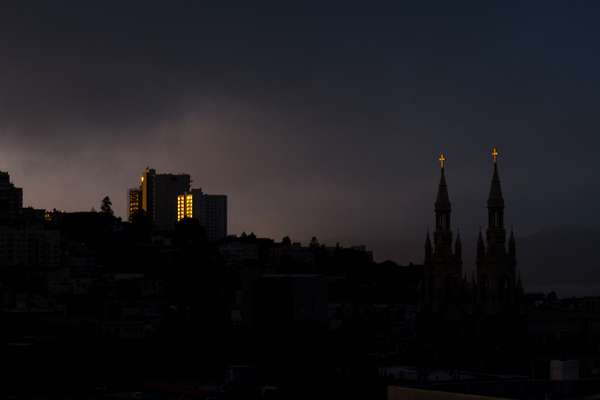
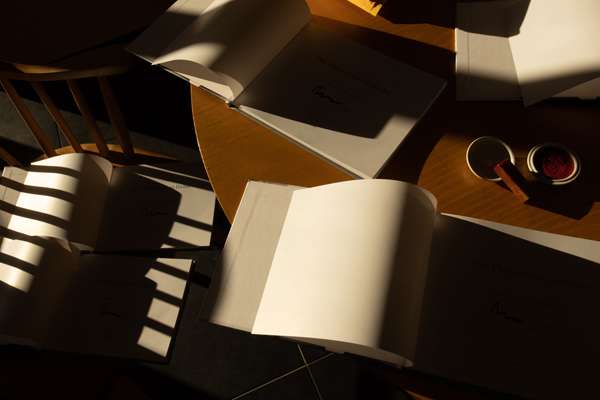
Simplicity is about the visual noise included in an image. A frame that was entirely white with a single apple in the center would be visually simple—there’s not much to draw our eyes away from the apple. But many photos have a great deal of visual complexity—the viewer’s eye bounces around from part to part, drawn to all sorts of ‘shiny objects’ – colors, textures, extraneous objects—these can be distractions to the message. A haiku is constrained and simple, and in a photograph I’d add, not unnaturally so. A solid white background is weird, or at least it can be weird. A haiku::photo will embrace simplicity, but it does so with an attention to being natural.
The hard part in demonstrating this simplicity in a photograph is not making it feel too contrived, or with artifice. And you know you’ve hit the sweet spot when your eye isn’t trying to figure out the subject, or tease it out from background noise. Notice in my haiku::photo examples below that they exhibit a lot of visual simplicity—not just a good contrast with the background, but using lighting, depth of field, and other optical properties to reduce noise and direct the viewer with purpose.
Don’t forget that the photo still must be haiku—simplicity alone isn’t enough. But with all the elements that make for a haiku::photo, make sure you’re really thinking through its simplicity.
Good luck, and have fun.”
— M. H. Rubin


How to participate:
First, view Rubin’s site. Once your feel you have a grasp of the principles, take some photos that align with this month’s theme. Select your best, and submit them below by midnight December 31. Voting runs January 3 – 10. Results, commentary and the new topic will be announced here on troutswirl on January 15. Good luck!
Note: This isn’t haiga! There should be no text attached to your photos. What we are looking for is, precisely, haiku::photo!
haiku::photo SUBMIT
Curated by internationally renowned photographer M. H. Rubin, haiku::photo is an opportunity to combine two areas of artistic knowledge. Anyone with a camera can explore the application of haiku principles to the craft of photography., first by viewing Rubin’s site, then by posting their best efforts related to our monthly theme here on the THF site. The result is a visual kukai, and results will be housed in the haiku::photo archive.

Comments (14)
Comments are closed.
my ability to understand the letter of what is said rather than the intention has again foiled me.
The instructions say to submit one image at a time. So I uploaded one, and then submitted. But now there is no form for me to submit the next two photos.
It might have helped if the instructions said to UPLOAD one at a time.
I apologize for not being a mind reader .. it’s been the bane of my life!! ;-) .. and I may well be misremembering the actual phrasing and simply misread ..
oops! I spoke too soon .. the form has returned .. apologies and please ignore my ignorance
Wow, what a great new feature, many thanks!
Loving this—it’s all so interesting and very enlightening.
Many thanks to M H Rubin for sharing his knowledge (and to THF for the feature)
marion
I really enjoyed reading the commentary together with these delightful photos. In a world where it’s so easy to experience visual overwhelm in digital form, haiku::photo provide a fresh perspective and truly elevate the image. Many thanks for the initiative Rubin, and to all the contributors!
I really appreciate the way you described your filtering process—especially the idea that a haiku::photo must feel like something unrepeatable, a moment you haven’t already seen a dozen variations of. That distinction between a technically strong image and one that actually carries a haiku sensibility feels particularly important. It’s fascinating to hear how you look for that extra ‘something’ beyond the surface of the photo.
Thanks so much Rubin for the honourable mention and your insightful, helpful commentary. Also, many thanks to THF for hosting this & the readers who also enjoyed this photo …my grandaughter in a free spirited moment. This haiku::photo genre is so interesting & really opens up new ways of looking at photography. I loved seeing everyone’s entries – such an array and so difficult to choose.
Thank you for choosing my image for comment. there were some interesting images.
This is an ocean swimming pool taken at dawn on a very clam morning when there is no surf crashing over the back of it.
Water fills naturally/ or is renewed at high tide – ocean pools are common in Australia providing a safe place to swim for those that prefer not to swim in surf.
I look forward to seeing future images
Thank you so much Rubin for choosing my photo “boy” and for your commentary. I’m finding haiku::photo very fulfilling, and I’m enjoying your self-paced workshop a lot! This type of photography really speaks to me. It’s wonderful to see everyone else’s work too. Thank you!
Wow! Thank you so much, M. H. Rubin, for selecting my photo for an Honorable Mention and commentary. I am truly honored as I found choosing just 3 terribly difficult. I am learning so much from everything you’ve written. I’m deeply grateful for this new forum for haiku creativity from THF.
To add a bit of wee context, this was almost exactly my first moment seeing the Eiffel Tower (and my 1st time in Paris). It felt otherworldly especially in the fog and was pretty much gray scale already. I’m so glad you saw the haiku within it.
congrats to photographers whose images have received comments and reader selections ..
kindly put comment to Dave Russo’s rooster next to his image ..
please give explicit information on how the submitted JPGs should be named ..
this is an amazing new addition to The Haiku Foundation. Appreciation to all involved
Maxianne
thanks, maxianne, i must not have updated when filling in dave’s commentary — i appreciate the prompt! and i’ll ask m. h. rubin to weigh in on how he’d like photo naming to be handled.
Please correct the submission and voting dates under the “How to Participate” section.
thanks, bernie!