
New to Haiku: Kire and Punctuation
As a new haiku poet, you may learn that haiku is composed of a fragment and a phrase, or that haiku is created through the juxtaposition of two images. The unique way that a haiku is crafted creates space for the reader to enter into the poem. In Japanese haiku, one achieves this kire, the break in the poem, through use of special words known as kireji. Since there are no English-language equivalents of kireji, we use punctuation (and to a lesser extent, form) to achieve a similar effect. Whether you choose to poke a tiny crack in your haiku for your readers to peek through or leave the door to your poem wide open is a matter of craft.
Kala Ramesh describes kire in this way:
The cut, known as the kire in haiku, is the most important technique and aesthetic tool we use when writing a haiku. What does it do? It creates that space between the images. In a minimalistic poem, how can one tell a story—where is the place for narration? The kire does this magic! It helps the author to link from one image to the next by creating a cut, which in turn creates “space.”
The kire forms the backbone and can be called the soul in haiku. A kire sometimes can occur anywhere in a haiku and it can happen more than once. It brings into focus the images that run parallel and the space between them.
- Kala Ramesh, in “The Heart of Haiku: The Cut (Kire),” in Contemporary Haibun Online 16.1 (April 2020)
I should note that some haiku scholars believe a haiku should have only one cut. Paul Miller writes:
“. . .If an uncut or half haiku is the cold porridge in the fairy tale Goldilocks, more than one cut could represent the other end of the spectrum—the too-hot bowl . . . Multiple cuts are often the result of trying to cram as much information as possible into a poem. They suggest a lack of trust in a single image’s ability to conjure more than itself . . .”
- Paul Miller, in “Haiku Toolbox: Some Thoughts on Cutting,” in Modern Haiku 48.2 (Summer 2017)
Regardless, kire is a key element of haiku. Let’s explore the various means by which haiku poets employ punctuation to achieve a break in the poem. When I was new to haiku, I struggled over whether to use no punctuation, an em dash, or an ellipsis. I had no idea there were so many ways to slice a haiku!
The following is not meant to be a comprehensive list, nor is it intended to present the myriad ways punctuation can be used within a haiku or senryu. I am hopeful, though, that it will provide you with a good starting point for thinking about how to create cuts in your haiku and senryu using punctuation. I’ve tried to list these roughly in order from most common to least-used.
No Punctuation
pond still no punctuation
- Brad Bennett, A Turn in the River (Red Moon Press, 2019)
Of the 505 poems in Hauling the Tide, the Haiku Society of America’s Members Anthology for 2024 (edited by Edward Cody Huddleston), more than half employed no punctuation marks, capitalization, or special formatting. For these poems, kire is created solely with word choice and line breaks.
birdwatching
the black metronome
of my cat’s tail
- Miriam Borne, Hauling the Tide (Haiku Society of America, 2024)
It’s clear from context how this haiku flows best: line 1, a break, and then lines 2 and 3 are read together.
birdwatching
the black metronome
of my cat’s tail
One advantage of eliminating punctuation is that you can sometimes create a pivot in line 2, such that the haiku can easily be read line 1, a break, and then lines 2 and 3 flow together, as well as lines 1 and 2 flow together, a break, and then line 3. See the following example, a 2016 Touchstone Award winner:
house clearance
room by room by room
my mother disappears
- Alan Summers, Blithe Spirit 26.1 (2016)
Line 2 – room by room by room – can be read as referring to either the house clearance or the poet’s mother, or, heartbreakingly, both at the same time. This technique of using a pivot line can give your haiku extra resonance—the impact of a fresh reading each time by providing more for the reader to ponder.
Extra Space
While this essay primarily focuses on actual punctuation marks, I wanted to highlight the unique ways that extra space can be used to create kire.
black and white penguins make the list
- Patricia Harvey, Hauling the Tide (Haiku Society of America, 2024)
Is this poem about a black-tie dinner? A new addition to the Endangered Species List? A black-tie dinner for endangered species? The extra space in this haiku invites multiple interpretations.
porch swing my feelings come and go
- Ce Rosenow, Frogpond 36:1 (Winter/Spring 2013)
This delightful poem above uses empty spaces to simulate a rocking porch swing. Julie Schwerin’s poem below is distinctly more somber.
in case one day we want out gaps in the border wall
- Julie Schwerin, Prune Juice Journal #42 (March 2024)
No Space (anti-kire haiku!)
On the flip side, John Stevenson gives empty space a new twist by leaving none whatsoever in this claustrophobic little haiku:
jampackedelevatoreverybuttonpushed
- John Stevenson, Haiku: The Art of the Short Poem (Brooks Books, 2008)
Ellipsis
An ellipsis is a good choice if you want to denote the passage of time or the tapering off of an image, event, or sound. In the following poem, the ellipsis also suggests cherry blossoms flying back into the air:
the housemaid
shakes her mop outside . . .
cherry blossoms
- Kirsty Karkow, 1st Honorable Mention, First Peggy Willis Lyles Haiku Awards (2013)
Em Dash
One of the most popular ways to cleave a haiku is by use of an em dash. Considered more immediate than the ellipsis, the em dash is a good way to convey a sudden aha! moment in which two things occur simultaneously. The following tragic and touching poem coveys this well:
landslide—
digging out bodies
to bury them
- Sreenath, Honorable Mention, Triveni Awards (2024)
The em dash can also create a visual representation of something linear, as in the following two poems:
sunbeam—
happy to be
just as I am
- Marianna Monaco, bottle rockets #16 (2007)
overgrown rhododendron—
I give the bees
one more day
- Julie Bloss Kelsey, The Heron’s Nest (April 2022)
Comma
Historically, English-language haiku were often punctuated like sentences, with a comma used to separate the two parts. While this practice has largely fallen out of favor, you can still find haiku published this way, such as this lovely poem:
The sky is grey,
an old duvet
to shiver under.
- Caroline Ridley-Duff, Haiku Dialogue (August 31, 2022)
P.H. Fischer uses a comma in the next poem to add a crucial pause in his haiku:
old home
the light we’d leave
on, off
- P.H. Fischer, The Heron’s Nest (December 2021)
A unique use of a comma can also be found in this haiga by Shloka Shankar. The haiku portion reads as follows:
where the sun gutters from the sky,
- Shloka Shankar, madswirl: a creative outlet (September 1, 2024)
Colon
My favorite haiku with a colon was written by the late Bill Pauly:
fall:
a spider laces
the trapper’s boots
- Bill Pauly, Modern Haiku 9.1 (1978)
Note the poem is shaped like a shoe with the colon forming the eyelets!
The next poem, by Shiva Bhusal, also sets the scene in line one by using a colon:
blizzard outside:
first slurp of the stew
burns my lip
- Shiva Bhusal, Hauling the Tide (Haiku Society of America, 2024)
Double Colon
I was unfamiliar with use of the double colon in haiku, but Robin Smith explained to me that some poets say a double colon is for an unweighted pause, while others use it almost like a tilde in math.
Because I lost you to the water :: shall I swallow the sweep of a river
- Grant Hackett, Roadrunner Issue IX: 4 (November 2009)
space-time continuum :: we become each other’s soliloquies
- Shloka Shankar, the field of why (Yavanika Press, 2022)
red rover :: playing for the break in the chain
- Anette Chaney, whiptail Issue 5 (November 2022)
Triple Colon
This extremely rare punctuation can be found in this clever poem by Minal Sarosh:
abacus:::
he counts Jupiter’s moons
again and again
- Minal Sarosh, Poetry Pea Podcast (April 2022)
Semicolon
Semicolons are not often found in haiku, but clearly their use dates back nearly 50 years, at least!
a monk turns his key
in the outer door;
spring
- Bill Pauly, Wind the Clock by Bittersweet (High/Coo Press, 1977)
autumn maple;
the old dog
lifts a leg
- Joan Cheng, Hauling the Tide (Haiku Society of America, 2024)
Hyphen
The hyphen is also not a typical punctuation choice for haiku, and I will admit that I used to confuse hyphens with em dashes in my early haiku days. This poem of mine, however, has the intentional use of a hyphen:
reading the night sky
I pause at a comma-
shaped moon
- Julie Bloss Kelsey, Frogpond 35.4 (2012)
Below, Mary Stevens uses a hyphen to make an effective cut in a one-line poem:
early morning light in the wave-tumble
- Mary Stevens, The Heron’s Nest Volume XXVII, Number 1 (March 2025)
Exclamation Point
Most of the examples of exclamation points I have found in haiku are humorous:
bellyflop!
in moon
water
- Bill Pauly, Modern Haiku 8.1 (1977)
tattoo!
tattoo?
tattoo
- Patrick Steadman, Millikin University Haiku Anthology (Bronze Man Books, 2008)
However, I did find this touching haiku recently published in The Heron’s Nest:
Bluebird!
all the sky
in the child’s voice
- Sanjuktaa Asopa, The Heron’s Nest Volume XXVII, Number 1 (March 2025)
Question Mark
The question mark is also not a common choice for haiku, but can effectively break a haiku into a question and a response, or a question and a reflection.
daddy, is that
where all the clouds come from?
power plant towers
- Eric A. Lohman, trash panda 1.2 (Winter 2021-22)
Period
While older English-language haiku and haiku translations often end with a period, it’s unusual to see one in the middle of a haiku.
unlit firefly. what use am I lost in darkness.
- Kat Lehmann, no matter how it ends a bluebird’s song (Rattle, 2025)
As Kat Lehmann explains, “With the full stops in middle and end, it mimics the firefly’s light turning off.”
Conversely, you could use all the periods, as in this whimsical visual haiku from petro c. k.:
…………………………………………..sandpiper
- petro c.k., Honorable Mention, Porad Haiku Award (2024)
Parentheses
Parentheses are not commonly found in haiku, but their use seems to be increasing. They can be employed to create alternate word options, double phrases, or to minimize certain words.
the a(n)esthetic of ableist thought
- Michael Morell, Trailblazer Contest Winner (2021)
(r)aging
- Barrie Levine, Honorable Mention, Marlene Mountain Haiku Contest (2022)
while(the clouds turn into rain)the lily blooms
- Norma Bradley, whiptail: journal of the single-line poem 7 (June 2023) – a Touchstone winner!
Fata Morgana the (in)visibility of my (dis)ability
- Debbie Strange, Second Place, Marlene Mountain Memorial Haiku Contest (2021)
(deleting the dictionary the mountain stream comes and goes)
- Kat Lehmann, no matter how it ends a bluebird’s song (Rattle, 2025)
no one takes ((cumulus ((me))diocris)) seriously
- Julie Bloss Kelsey, dadakuku (January 17, 2025)
For the last, I could have written the haiku in this format:
no one takes me seriously cumulus mediocris
but I wanted to capture the shape of these (boring) cumulus clouds as well as the isolation I was feeling. This one is definitely leaning toward the experimental side of haiku!
And, for more experimental fun, consider these lesser used punctuation marks. Note that they still work to create a break within the haiku.
Slash
hummingbird
is/is
not moving
- Bill Pauly, High/Coo 12 (1979)
There’s something whimsical about the slash in Bill Pauly’s poem. You can almost see the center of the hummingbird and hear the whirr of its wings.
i saw / see
- Jill Kessler, whiptail Issue 5 (November 2022)
For this poem, Kat Lehmann points out: “The slash is both concrete and disjunctive in that it makes me want to flip the order to create a see-saw.” For me, this poem brings to mind a child trying to explain what they’ve seen to a grownup—an intriguing little poem!
Quotation Marks
“Well, I heard it was a car accident . . .”
old college roommates
discuss the dust
- Joshua St. Claire, Poetry Pea Podcast (April 2022)
a “forever stamp” on a letter to the ocean
- Fay Aoyagi, Haiku 21: An Anthology of Contemporary English-language Haiku (Modern Haiku Press, 2011)
Tilde
gusts of wind
in the playground~
undulating laughter
- Paul Callus, Poetry Pea Podcast (April 2022)
Horizontal Line
— slicing through —
— my daydreams —
—— contrails ——
- Julie Bloss Kelsey, Chrysanthemum 23 (Spring 2018)
the following line is true
⎯⎯⎯⎯⎯⎯⎯⎯⎯⎯⎯⎯dawn horizon⎯⎯⎯⎯⎯⎯⎯⎯⎯⎯⎯⎯
the previous line is false
- Edward Cody Huddleston, Trailblazer Contest Winner (2024)
Strikethrough
awaiting my doctor’s signature
monologue
- Helen Buckingham, Poetry Pea Podcast (April 2022)
self
- Antoinette Cheung, whiptail Issue 5 (November 2022)
mousetrap
- Julie Bloss Kelsey, whiptail Issue 5 (November 2022)
Pipe Symbol (Vertical Lines)
add | | voice | | to | | sea | | rain
- jim kacian, Trailblazer Contest Winner (2023)
Interpunct
ray · leigh scat · ter · ing my in · ter · net per · so · na
- Robin Smith, Prune Juice Journal 44
Asterisk
yes*
- P. H. Fischer, hedgerow #146
the mouse
faster than the mind
*click bait*
- Sarah Paris, Poetry Pea Podcast (April 2022)
Grawlix (All the Punctuation!)
! ; v e $ m @ + + e < ! e $ $
- P. H. Fischer, Haiku Dialogue (January 26, 2022)
Mathematical Symbols
the moon x the moon ÷ the moon
- Fay Aoyagi, roadrunner, Issue 10.1 (2010)
and even Musical Notation
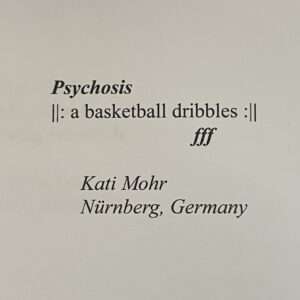
My apologies to Kati—I couldn’t figure out how to make “as fortissimo as possible” in WordPress! I also added two extra spaces because WordPress wanted to make a “meh” smiley face on the right side. This was as close as I came:
Psychosis
|| : a basketball dribbles : ||
fff
- Kati Mohr, Hauling the Tide (Haiku Society of America, 2024)
Do you have a favorite punctuation mark? (I’m fond of the interrobang!?) Let me know in the comments!
We’d love to hear from you in the comments. The Haiku Foundation reminds you that participation in our offerings assumes respectful and appropriate behavior from all parties. Please see our Code of Conduct policy for more information.
For More on Kire:
Miller, Paul. (Summer 2017). “Haiku Toolbox: Some Thoughts on Cutting,” in Modern Haiku 48.2.
Ramesh, Kala. (April 2020). “The Heart of Haiku: The Cut (Kire),” in Contemporary Haibun Online 16.1.
For More on Haiku and Punctuation:
Brooks, Randy. (2023). “Punctuation Words in English Haiku,” in Frogpond 46.1.
McGuire, Patricia. (April 18, 2022). Original haiku & senryu with punctuation. The Haiku Pea Podcast, Season 5, Episode 8.
Welch, Michael Dylan. (Last update 2022). “Punctuation in Haiku,” Graceguts.
Whipple, Allyson. (2022). Haiku Punctuation Presentation, Poetry Pea Workshop.
My thanks to P.H. Fischer, Kat Lehmann, and Robin Smith for their helpful suggestions on earlier drafts of this post, and to my husband John Kelsey for giving it a last minute once-over. Any remaining errors are mine.

Comments (9)
Comments are closed.
Since in English-language haiku we don’t use specific cut words, we have the option of making the cut ambiguous. In the following haiku (Asahi Shimbun 2025) I used “and” to make the cut weak so that the reader wouldn’t be sure until after having read the whole thing.
News of war
and the deer
eats my seedlings
Thanks a lot for the informative post about the diverse possibilities.
Thank you Julie! It was crisp and clear and i shall surely save this!!
Thank you Julie for this thorough compilation illustrating everything we need to know about punctuation in haiku. It will be my go-to and trusted resource from now on. I conduct a class for new mentees through HSA and we will surely refer to your examples in our workshops. I was excited to see my own poem here illustrating parentheses, thank you kindly for your appreciation of my work.
This was a fun and inspiring read. I’m sure it will lead to some great discussions at the next meeting of our haiku group. Thanks, Julie!
Fantastic to see so many different forms of punctuation. Thank you for your extensive research Julie.
I hesitatingly used an exclamation mark for emphasis in one of my haiku last year, not really sure if it was an accepted thing to do, and was delighted it was awarded Highly Commended in the Haiku section of the 2024 New Zealand Poetry Society International Poetry Competition
thunderclap!
a godwit tucks it beak
back into its back
~Sue Courtney
New to Haiku is consistently my favourite feature of THF’s website. Like so many, this entry was a delight with its diverse selection of inspiring haiku and illuminating commentary.
Wonderful selections to illustrate one of the trickier aspects of modern ELH, Julie!
Great resource – thank you for sharing this